THE STAGE 32 LOGLINES
Post your loglines. Get and give feedback.

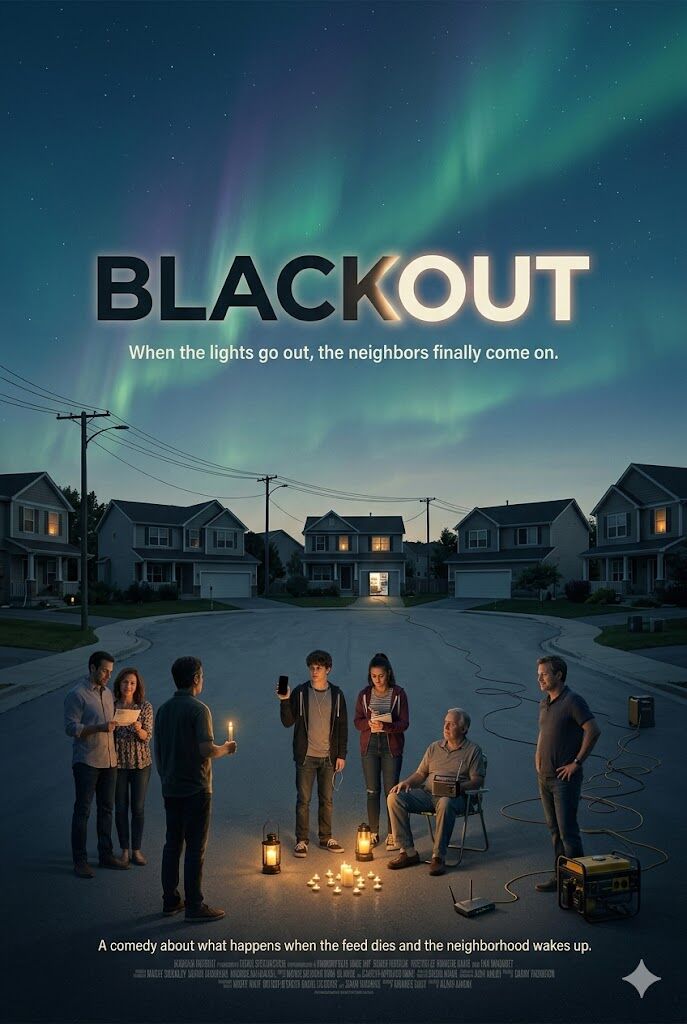
BLACKOUT
By Joseph Murkijanian
When a solar flare wipes out power and Wi‑Fi for weeks, a suburban cul‑de‑sac of screen-addicted families and oddball neighbors is forced offline into each other’s lives, stumbling—often hilariously—into the messy business of becoming a real community.
SYNOPSIS:
BLACKOUT – Synopsis
When a once‑in‑a‑century solar flare nukes the internet and power grid for weeks, the residents of Maple Grove—a painfully normal suburban cul‑de‑sac—are forced to do something truly terrifying: look up from their phones and talk to whoever lives next door.
At first, it’s just weird. The sky glows green, every screen dies mid-scroll, and a street full of adults armed with advanced degrees suddenly cannot operate a flashlight without an app. Teenagers Jaylen and Megan sit on the front steps, mashing dead power buttons like that will bend reality, genuinely offended that batteries still exist. Donna and Carl discover they own two cans of chickpeas, eight food delivery apps, and no actual food. Gary, the resident “I told you so” prepper, fires up his beloved generator and announces he can keep the fridge, a lamp, and—awkward pause—the garage beer fridge running.
As the outage stretches from “annoying” into “oh, this is our life now,” the cul‑de‑sac staggers into its first neighborhood meeting on Dennis and Ruth’s porch. It goes about as well as you’d expect for people who’ve lived thirty feet apart for years and still refer to each other as “the dog people” and “the flag house.” They have to start with the basics: names, house numbers, and the shocking revelation that the quiet guy at number six, Sol, has been there for thirty‑one years and is not, in fact, a ghost.
What follows is a deeply human, accidentally funny crash course in analog living. Gary builds an increasingly elaborate “generator system,” complete with clipboards and a lawn‑chair “security perimeter,” then has to be gently bullied into prioritizing Helen’s CPAP machine and the Patels’ insulin over his craft beer. Donna resurrects her mom’s handwritten recipes and learns what a chickpea actually is. Carl discovers that dirt smells amazing when you’re growing something in it and that tomatoes have a smell before they’re on a burger. Megan starts a handwritten blackout journal because there’s no feed left to perform for; Jaylen, trying to write for the first time without an edit button, comes up with the startling observation that there’s an old man two houses down who has apparently existed his entire life.
The comedy comes from recognition: from watching smart, competent people reduced to confused raccoons when you take away Wi‑Fi; from a generator being treated like a minor deity; from two teens trying to have their first real conversation and debating whether this even counts as “a conversation” or just “the skeleton of one.” But as the weeks pass and the aurora fades, the jokes give way to something more honest. They learn to pool food instead of hoard it, to knock on doors instead of refresh feeds, and to sit on porches where, somehow, decks of cards and a crackling radio feel more powerful than any push notification.
By the time the power finally surges back, and every phone in Maple Grove lights up like a slot machine, the real question isn’t whether the internet will return. It’s whether anyone on this one little street—these teens, these parents, these stubborn, hilarious, lonely people—actually wants to go back to the way things were before the world went dark and the neighborhood finally lit up.
 Register / Log In

Rated this logline
Rated this logline