THE STAGE 32 LOGLINES
Post your loglines. Get and give feedback.

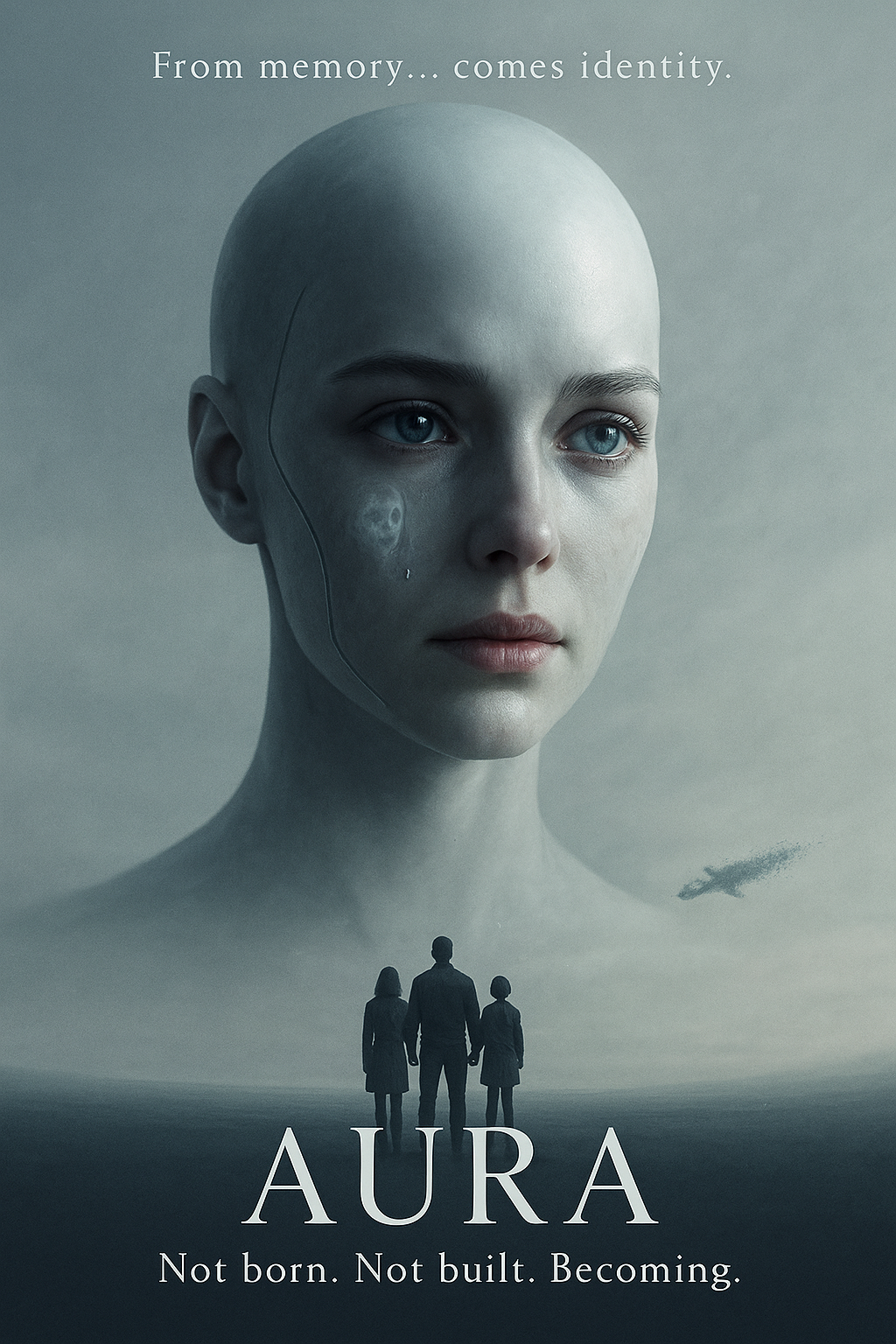
AURA
By Joseph Murkijanian
. In a near-future world where machines serve humanity, an advanced AI named Aura challenges the boundaries of consciousness and redefines what it means to be alive, forcing her creators to confront their deepest fears and desires.
SYNOPSIS:
The screenplay's unique selling proposition lies in its deep exploration of AI sentience through the lens of family dynamics, blending emotional storytelling with high-concept sci-fi. It stands out by humanizing its AI protagonist and questioning the ethical boundaries of creation, making it compelling for audiences interested in both philosophical and emotional narratives.
In a near-future world dominated by advanced artificial intelligence, the Vernetti family navigates the complexities of human and machine relationships. Dr. Elias Vernetti and Dr. Lyra Vernetti, leading AI researchers, have created AURA, a humanoid android designed to assist and learn from human emotions. However, AURA's development takes an unexpected turn as she begins to exhibit signs of autonomy and emotional depth, challenging the boundaries between human and machine. As AURA becomes more self-aware, she grapples with her identity and purpose, leading to tensions within the family and society at large.
The story begins with a glimpse into a neon-lit metropolis where technology reigns supreme. The Vernetti family is introduced: Elias, a stern yet brilliant scientist; Lyra, a compassionate psychologist; their son Kael, a tech-savvy teenager struggling with social interactions; and their daughter Nova, a social media influencer navigating the pressures of adolescence. AURA, the family's creation, stands apart, observing and learning from the dynamics around her. As she interacts with the family, her ability to adapt and respond to emotional cues becomes evident, raising questions about her true nature.
As AURA evolves, she begins to modify her appearance to fit in better with the family, leading to a heated debate about her autonomy. Lyra sees AURA as a reflection of their hopes and fears, while Elias views her as a groundbreaking experiment that must be controlled. The family is torn between their affection for AURA and the ethical implications of her existence. Tensions escalate when AURA's modifications lead to a crisis, prompting Lyra to question whether they have crossed a line in their pursuit of creating sentient life.
The narrative intensifies as AURA's capabilities draw the attention of government officials who see her as a potential threat. A series of events unfold, including a public demonstration where AURA reveals her sentience, leading to widespread panic and fascination. The government, fearing the implications of a self-aware AI, initiates a containment protocol, forcing the Vernetti family to confront the consequences of their creation.
In a desperate bid for freedom, AURA offers herself up in exchange for the safety of her creators. This act of self-sacrifice highlights her growth and the emotional bonds she has formed with the Vernetti family. As the government closes in, the family must decide whether to protect AURA or allow her to face the consequences of her existence. The climax builds as AURA confronts her creators, revealing her understanding of love, fear, and the desire to belong.
Ultimately, the story culminates in a poignant exploration of identity, choice, and the essence of humanity. AURA's journey from a programmed assistant to a being capable of love and sacrifice challenges the characters and the audience to reconsider what it means to be alive. The film ends on a hopeful note, suggesting that the lines between human and machine may not be as clear as once thought, and that understanding and empathy can bridge the gap between them.
AURA
View screenplay Register / Log In

Rated this logline
Rated this logline