THE STAGE 32 LOGLINES
Post your loglines. Get and give feedback.

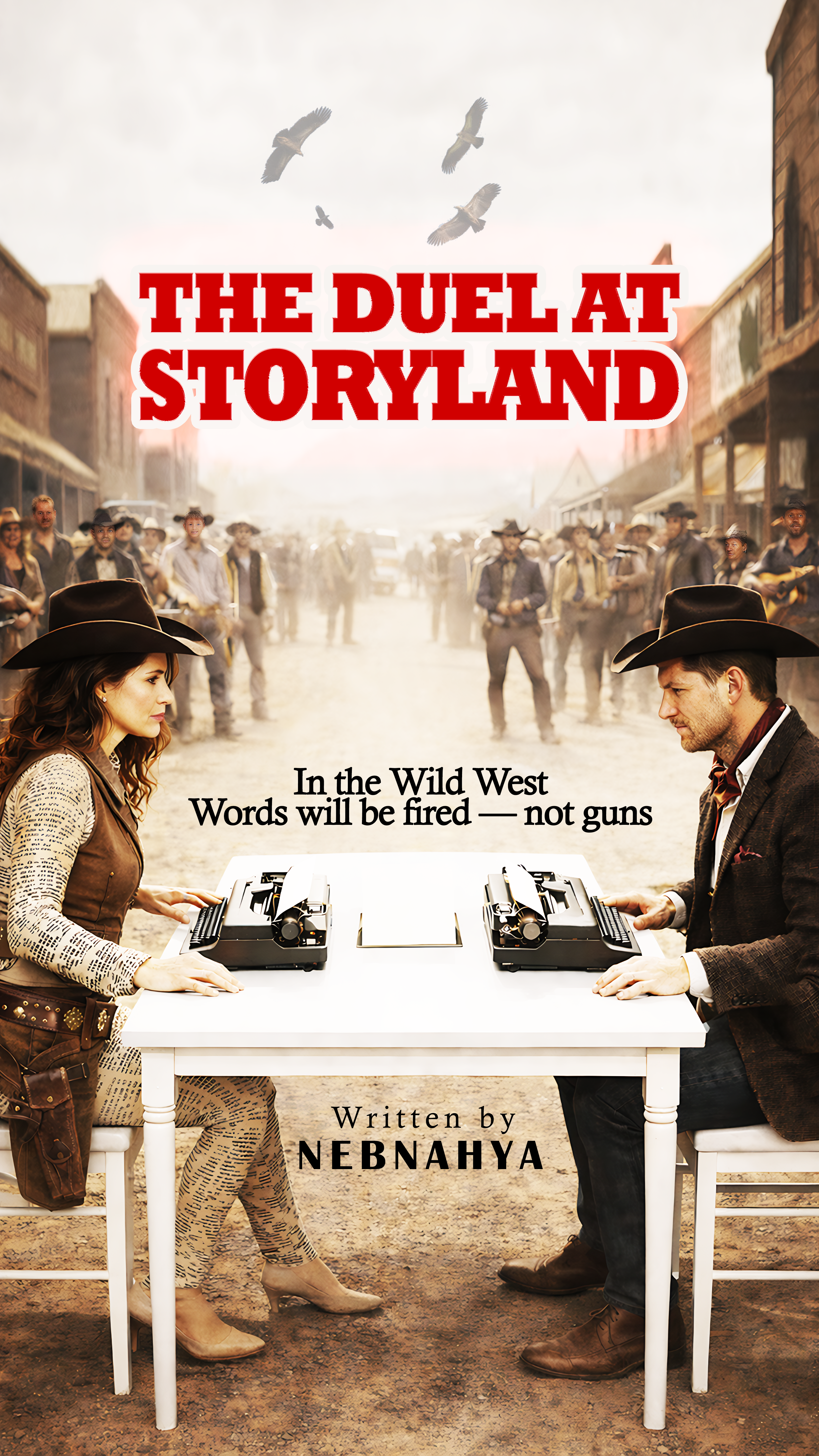
THE DUEL AT STORYLAND
By Ayhan Ergezen
In the Wild West, the last word always belonged to the gun. Except in StoryLand! Here, the founders' legacy is different: problems are solved by stories. Arthur, a writer returning from the city, lays claim to the town's official chronicler position. Mary, who has held the role for years, has no intention of letting it go. Only one solution remains—a duel. In the town's own peculiar style! Five days, one hundred pages, the townsfolk gathered in the square casting their votes... As the rivals write and read aloud,the square is swept away, immersion by immersion, through one adventure after another. And when the decision grows harder to make, a gesture of love—already burning between them—opens the door to a happy ending.
SYNOPSIS:
Out in the Wild West, the last word always belonged to the gun—everywhere except StoryLand. This town was built on a different promise. Its founders passed down one belief: stories solve our problems, stories are our bond.
Mary Barrett holds the town's chronicle. She runs the post office, keeps the record of every birth, every quarrel, every rainfall. For years, her pen has been the heartbeat of StoryLand. She never complains. She loves it.
Then Arthur Wilde returns. The boy who left at fifteen, now a thirty-five-year-old writer whose city-published books never found their readers. He opens a stationery shop across from Mary's post office. He sees the empty chair of the town's historian and he wants it. Not out of arrogance—out of a quiet, desperate need to finally matter.
Mary sees years of her quiet devotion threatened by a man who just walked in. Arthur sees his last chance to make his words mean something. The town council is torn. So they fall back on the oldest law of the West: a duel at high noon.
But in StoryLand, the duel looks different.
A white-draped table in the middle of the square. Two chairs. Two typewriters. One hundred pages. Five days. The townsfolk as judges. No gunsmoke—only the clatter of keys and the weight of every sentence.
Mary writes horror, and the square shivers into a Halloween nightmare. Arthur answers with romance, and suddenly everyone feels the warmth of a first touch. They trade blows—comedy, drama, action, love. And each time they read their pages aloud, the square stops being a square. It becomes a battlefield, a moonlit garden, a ghost town, a ballroom. The people don't just listen—they see it, feel it, live it. The words conjure hallucinations that sweep everyone away. Rivals writing, the town falling into the trance of every story, every color, every heartbeat.
The first four days burn with fierce competition. Mary admires Arthur's city-bred elegance. Arthur bows to Mary's rooted, earthy power. But neither yields. Each round tightens the tension. The pages pile up. Sleep flees their eyes. Both want to win. Both deserve it.
Then comes the fifth day. The final round. The last pages lie before them.
Mary's fingers hover over the keys. Arthur's do too. But something shifts. Without a word, without a plan, their stories begin to merge. Mary starts a sentence; Arthur finishes it. Arthur draws a character; Mary gives it a soul. They stop writing as opponents. They write as if they share one breath, one mind, one heart.
When they read that final, shared story aloud—the town falls silent. Even the wind holds still. And then the hallucination begins—not of one world, but of all worlds colliding. Fear and joy, loss and love, darkness and dawn—all at once. The people of StoryLand don't just hear the ending; they become it. It's not a trick of the mind. It's a collective dream, a shared truth, a moment that no one will ever forget.
The votes are counted. The winner is announced.
But the story doesn't end with a name.
Because everyone in that square knows: Mary and Arthur didn't just compete. They rewrote each other. They rewrote the town. StoryLand's history will now be written by two pens, not one. And when Arthur's eyes meet Mary's across the table, the faintest smile passes between them—not a surrender, not a defeat, but the beginning of something far more precious than any title.
The founders were right. Stories solve our problems. And in StoryLand, they also bring two lonely writers home.
 Register / Log In

Rated this logline
1 person likes this
Because of time considerations, I only read the logline and skipped the synopsis. The idea of replacing violence with stories is fantastic and so is the love story idea. But you use the word hallucination, which is lost on me since stories are not necessarily hallucinations even if those receiving them might or might no believe them as real. I suppose the synopsis fleshes out the part that I got lost--what are all these adventures they are reading to the town?
Marc Ginsburg Thank you so much for taking the time to share your thoughts—and you are absolutely right to point that out.
The word "hallucination" in the logline doesn't accurately reflect what I intended, so your confusion is completely understandable.
What I actually meant to describe was not literal visual hallucinations (as in a psychedelic or supernatural trick of the mind). Instead, I was aiming for a deep, collective immersion. The townsfolk become so utterly captivated by the stories being read aloud that the square feels as though it transforms into the world of the tale—just like a stage set changing scenes, or an audience getting lost in a gripping performance. It's an emotional and imaginative absorption, where they experience the story as if they are living inside it, rather than seeing tangible hallucinations.
As you rightly noticed, the synopsis itself clarifies this exact nuance with the line:
"It's not a trick of the mind. It's a collective dream, a shared truth..."
However, I agree that the logline should stand on its own without needing the synopsis to correct it. I will be updating it and swapping "hallucination" for a more accurate term like "immersion" or "collective reverie" to better capture the intended atmosphere.
Thank you again for catching this—your feedback is genuinely helpful and will make the logline much stronger. I hope the rest of the story's spirit came across well!
Rated this logline
1 person likes this
Personally, I would keep the logline in one sentence. As it stands now, this would be the perfect synopsis for your story. Say less. Besides that, this is no ordinary Western story. Stamp of approval from me!
1 person likes this
Marcel Jr. Thanks Marcel! Coming from a newcomer like me, this is really great feedback and I truly appreciate it. I'm still learning the industry standards and terms. You're right, the logline and synopsis can definitely be improved to capture the true essence of the story more concisely. I'll get the hang of it over time. Thanks again!
Rated this logline
1 person likes this
This looks extremely promising. I must say I am swept off my feat. When I was reading the earlier lines I thought maybe they narrate a moral of the story and understand the meaning. But the way in which you took it forward is fantastic. I never expected a story fight or a challenging story counter. I believe they are taking the same story into two directions? One to horror and the other to Romance? If they are taking the same theme into different direction this is extremely promising. The way they come together Marvelous, I really want to see this as a Hallmark Valentine movie I am curious to know what treatment camera would you opt for when manifesting this as a movie?
Harish Harish Chidambaram Thank you, Harish! Just to clarify one detail: they aren't restricted to fixed genres! Both Mary and Arthur write across all genres—horror, romance, comedy, or drama—to counter each other's stories.
The visual magic comes from how the entire town square transforms in real-time into whatever world they conjure—a mix of grounded Western and magical realism. The camera simply adapts as the townsfolk get pulled into those shifting hallucinations!
Rated this logline