THE STAGE 32 LOGLINES
Post your loglines. Get and give feedback.

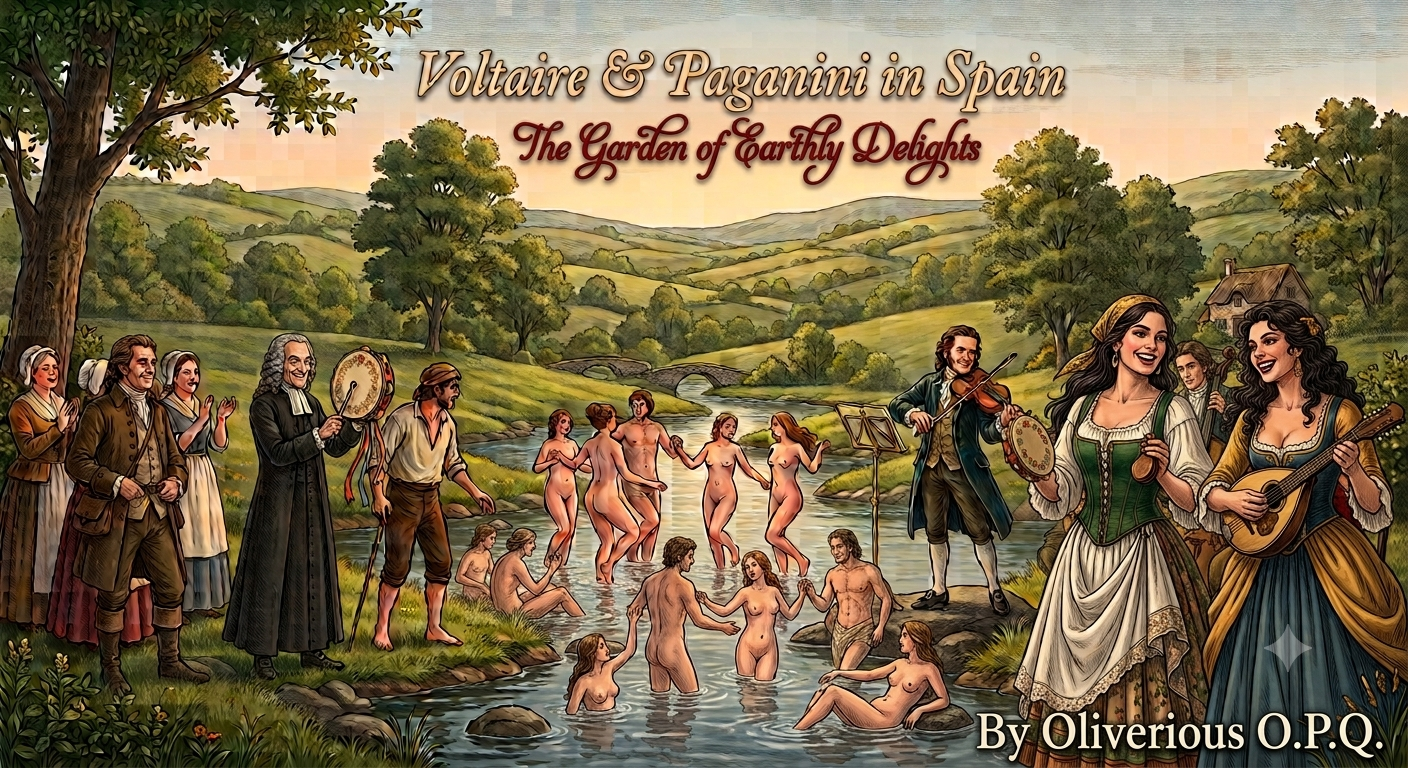
VOLTAIRE & PAGANINI IN THE SPANISH PARADISE
By OLIVERIOUS O.P.Q.
Voltaire and Paganini set sail from France for England. Aboard the ship, they debate matters both worldly and divine. Under the cover of night, four men cast them overboard. The waves wash them ashore onto the coast of Spain. Voltaire fears for his life, knowing that if the Inquisition unmasks him, he will be burned at the stake. Yet the reality awaiting them comes as a profound shock: Spain has become a haven of political, religious, and sexual freedom.
SYNOPSIS:
Voltaire & Paganini in the Spanish paradise by Ismael Camargo
An earthquake destroys a Spanish city. As survivors recover the bodies of the dead, a man (an
actor who arrived in the city that same day) begins a speech. This orator blames the libertines
for having unleashed God's wrath. Religious sentiment touches the hearts of those who listen,
and before a cross, they swear to live austere and sober lives. They light a bonfire and throw in
their jewels, perfumes, portraits, and mirrors, and then begin to destroy the statues in the city,
especially the funerary monuments.
The actor (accompanied by a group of friends, including a young woman from the aristocracy)
crosses the river that divides the city in two. There, he gives a second speech, this one about
the brevity of life and the folly of postponing love, pleasure, and life until tomorrow for fear of
others' opinions. He is so persuasive that right there, on the riverbank, a joyful and unrestrained
celebration of life erupts: everyone declares their love for one another, and no one refuses to
participate.
A group of the religious zealots who were flagellating themselves on the other side of the river
watch the celebration and see only depravity. They tell the others what they have witnessed,
everyone arms themselves and goes to punish the devil's followers.
And the battle begins, and blood begins to flow.
The actor mounts a fine horse and rides into the heat of the battle.
I am the King, and I will punish with death anyone who does not throw down their weapons at
this very moment."
The battle instantly subsides.
So convincing is the actor's performance that five minutes later he is attacked by the King's
enemies, his friends defending him manage to save him.
Part Two.
Voltaire and Paganini sailed from France to England. On deck they talked of God and man. Forty
people traveled with them. Thirty-nine laughed along. That night four men threw the “impious” into
the sea. Voltaire for being Voltaire. Paganini, for having "made a pact with the devil."
The waves left them on a beach. They looked at the stars and discovered they were in Spain, the
stronghold of the Inquisition. Both men were afraid. If found, they would burn. They walked toward
France. Half a league on, Paganini heard singing. French words, in the trees. The voice belonged to
Jacques the Fatalist.
"Jacques. What are you doing in Spain?"
"I work for a bookseller. A nobleman, from La Mancha. He knows books, chivalric novels most of all.
At fifty he loaded his wagon and left home. The house was driving him mad.”
The bookseller appeared and joined. He was tall and thin.
"Last time I saw Jacques," Voltaire said, "he was telling me about his love affairs. He never finished."
"It was written. That we would meet in Spain. That the story would end here. And if you came to die
like Joan of Arc, there's no help for it. Don't worry."
The four became friends fast. God and man—that was the thing they all loved to argue about.
They reached Seville. Freedom there was total. Political. Religious. Sexual. This was not Spain. This
was the Garden of Earthly Delights.
"It started," the bookseller said, "after the earthquake took Lisbon. A thing that size makes people
think. About life. Death. Good, evil. Body, soul. Lisbon changed overnight. Spain followed. Or vice
versa, people are arguing about this now.”
Prostitution had disappeared. Rich and poor enjoyed love and beauty, only merit was considered.
Paganini stood barefoot in the river, playing Spanish songs for a crowd of lovers who'd made a party
out of nothing. The others watched, with a troupe of actors they'd met along the way. Jacques
noticed the cart was gone. They followed the tracks two leagues and caught the thief. He said he
wasn't one. Young. Dark-skinned. Aquiline nose. An accent none of them knew.
A native of the Indies.
"An army is coming to burn this city," he said. "All of Spain. I only wanted to save the books."
They looked back. Seville was already burning.
The native told them what he knew.
“A couple of years back, in San Antonio, Texas, they staged Don Juan. All Spaniards—gentlemen and
ladies—laughed all night, because a Comanche played the part. Every tribe that heard it took it as an
insult. Comanche. Apache. Cheyenne. Cherokee. Chichimeca. Tlaxcaltec. They organized. The
English brought them across the water.”
Voltaire looked at him. He was certain now—this was the actor who had played Don Juan. He had a
beautiful voice and a certain majesty that made him think of Moctezuma. Still, the casting struck
him as absurd. Voltaire wanted to turn it over. There was no time for that now. Now it was urgent to
decide: flee, or return to fight. Seville was burning.
All eyes went to the bookseller.
Voltaire knew: whatever this man chose, Jacques would follow. So would the rest. So would he. So
would the rest. So would he. The old man's eyes lit up the way an old man's eyes light up when he
decides to do what only the young do.
 Register / Log In

Rated this logline