THE STAGE 32 LOGLINES
Post your loglines. Get and give feedback.

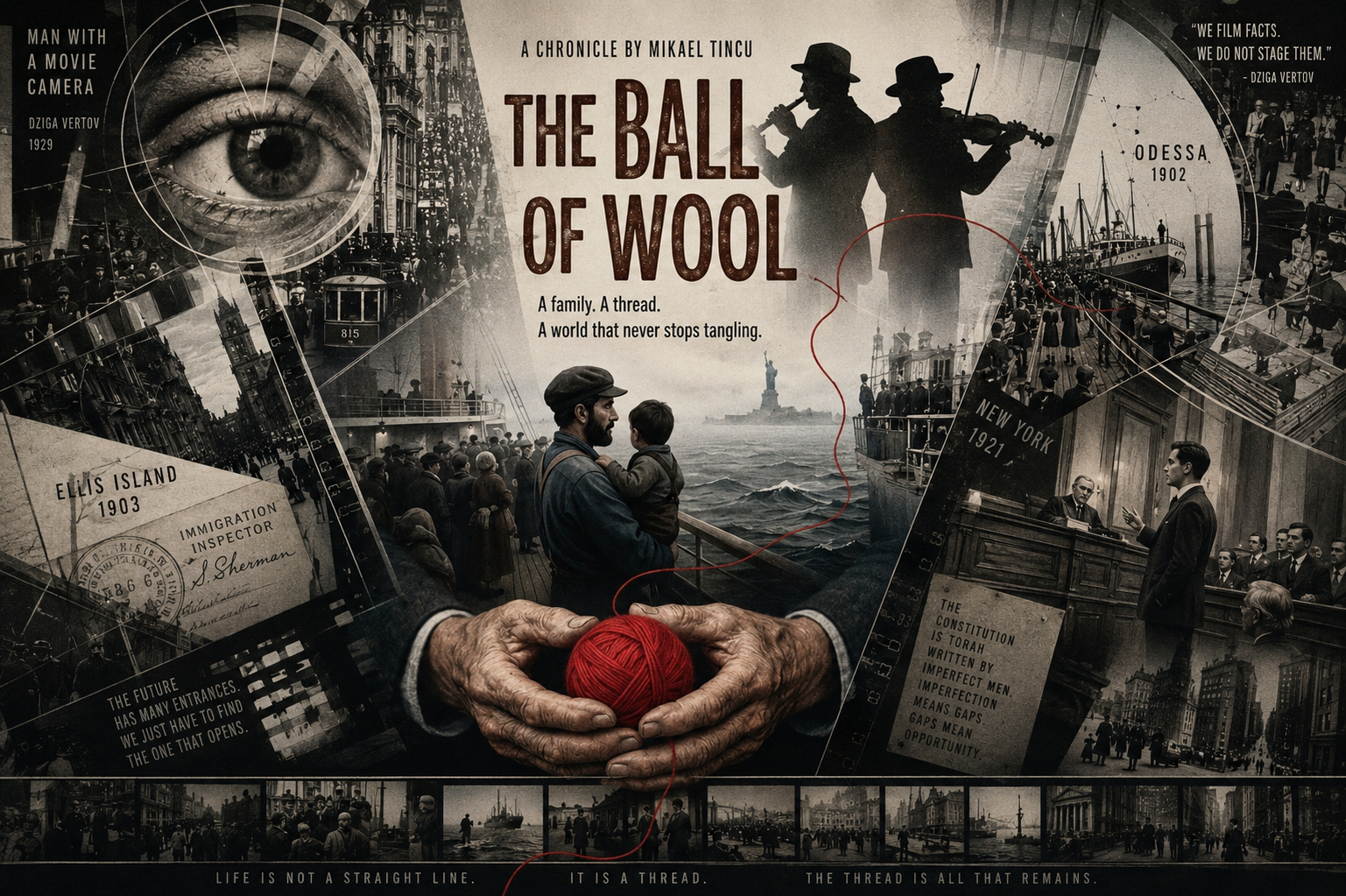
THE BALL OF WOOL
By Mikael Tincu
SYNOPSIS:
FORMAT: Feature Chronicle TONE: Mel Brooks meets Sergio Leone meets Charlie Chaplin OVERVIEW History does not move in straight lines. It tangles. The Ball of Wool is a cinematic chronicle built around a single, tangible object passed from hand to hand across three generations of the Sherman family: a red ball of wool that survives every crossing, every loss, and every reinvention. The film opens and closes with 87-year-old Solomon Sherman on a New York park bench holding the wool. From there, the narrative unspools backward and forward simultaneously—spanning Odessa, Kishinev, the Atlantic, Ellis Island, and Manhattan. THE GENERATIONS 1902–1903 (The Arithmetic of Survival): Avrum Shlemovitch, a practical Odessa port worker, navigates the Kishinev pogrom through cool calculation. Seeing America as the only different number he knows, he flees across the Atlantic, carrying the red wool to hand to his son. 1921–1962 (The Subversive Translator): Renamed Solomon at Ellis Island, he discovers the American courtroom and realizes the Constitution is a Torah written by imperfect men. Navigating grey zones with paperwork rather than violence, he builds a formidable law firm using the "Odessa method". 1965–PRESENT (The Natural Continuation): Solomon's grandson, Danny, redirects the firm's legacy. The "Odessa method" of navigating grey zones for survival transforms into constitutional arguments for civil rights in the 1960s. THE CINEMATIC VISION The film blends the rapid, multiple-exposure documentary realism of Dziga Vertov with the saturated, weightless memory-scapes of Marc Chagall. Driven by a rich sonic architecture that traces a melodic thread from Carpathian birds to traditional klezmer clarinet and American jazz, the film asks a quiet question: what happens when the thread continues, but the memory does not?
 Register / Log In

Rated this logline