THE STAGE 32 LOGLINES
Post your loglines. Get and give feedback.

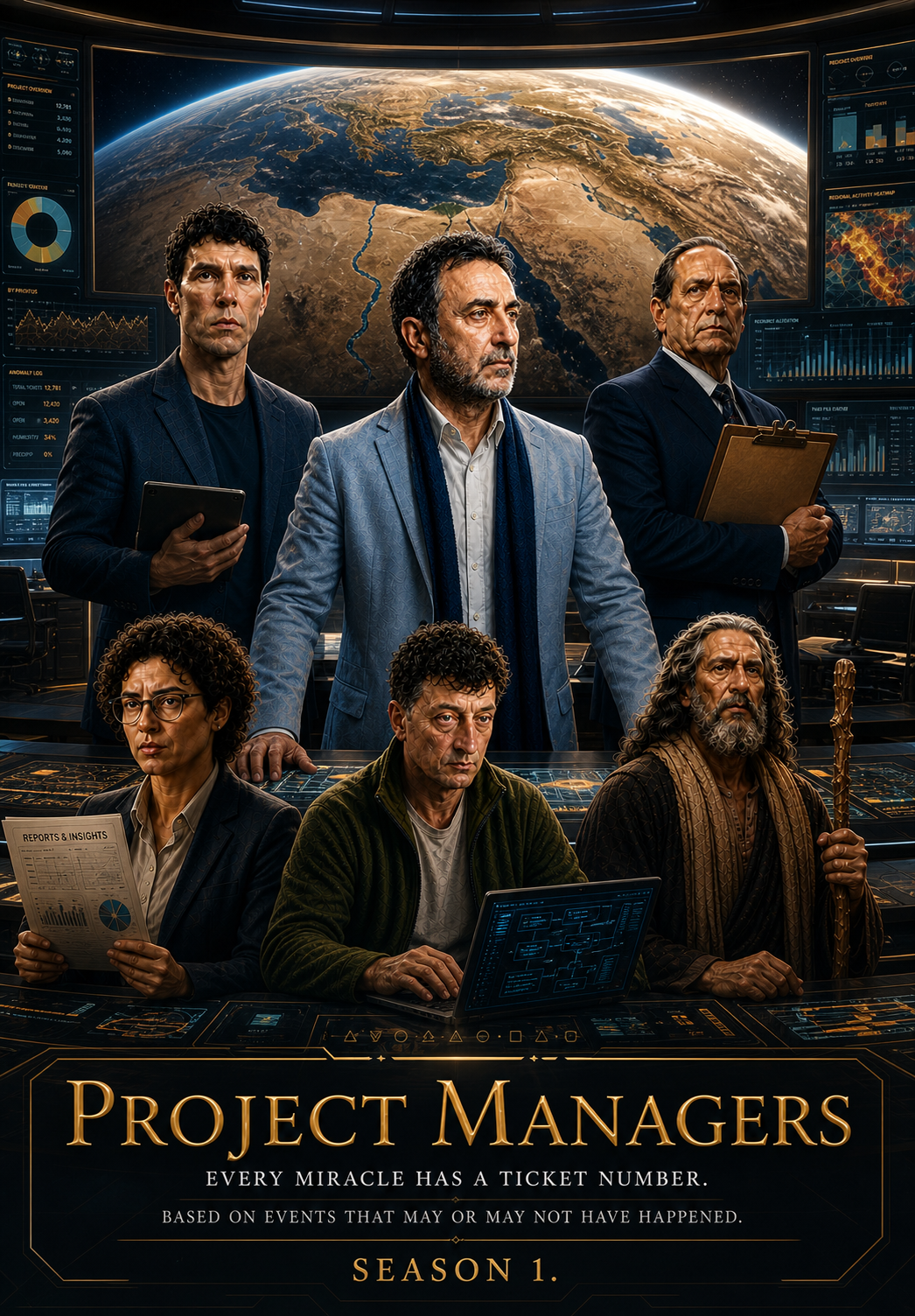
PROJECT MANAGERS
By Eugene Cuprin
When Earth's millennia-spanning evolution project is marked for shutdown by the celestial Oversight Board, a burned-out YHVH Corp engineer—haunted by his catastrophic failure in Gomorrah—must outwit rival divine corporations, fix plagues, deploy miracles, and log every bug into a biblical chapter before humanity becomes another closed ticket.
SYNOPSIS:
PROJECT MANAGERS Sci‑fi drama / dark office satire
Tagline: Every miracle has a ticket number.
When the gods turn out to be middle managers, faith becomes a corporate KPI.
In Project Managers, the Bible is reimagined as a messy, centuries‑long product launch run by competing alien corporations. Humanity is a legacy client. Earth is the test environment.
Series overviewFar beyond our galaxy, rival extraterrestrial companies race to upload their knowledge, tech, and culture into a young, chaotic planet called Earth. Each brand chooses its own strategy. The Egypt and Mesoamerica teams build pyramids and carve data into stone, betting on monuments that outlive empires. The Greeks roll out “soft” infrastructure—democracy, courts, theater—so that humans level up on their own through social evolution.
The most aggressive player is the YHVH Corporation, a volatile disruptor that treats an entire people as a closed beta. Instead of building temples or schools, they rewrite human DNA, encoding a vast alien “Wikipedia” directly into a bloodline. The only way to unlock this buried library is a textual cipher that must survive intact for millennia. That cipher is the Torah.
Season oneSeason one reframes the biblical arc from Exodus to the Second Temple as a project that was supposed to take decades and quietly mutates into a multi‑century maintenance nightmare. The “heavenly” HQ operates like a stressed‑out Big Tech campus: open‑plan war rooms, dashboards full of red alerts, and a board of directors demanding miracles on schedule and under budget.
YHVH is not a deity but the mercurial CEO of the local Earth account—a brilliant, bipolar control freak who oscillates between visionary pivots and catastrophic micromanagement. He is jealous of rival portfolios, obsessed with his brand, yet capable of cutting ruthless, pragmatic deals with Egypt, Babylon, Greece, and Persia when metrics demand it.
Dual POV engineThe show’s engine constantly cuts between two layers of the same events:
In orbit, in the sleek alien offices, product managers, system architects, and PR leads argue over KPIs, feature creep, compliance with cosmic regulations, and how to spin another “plague” in the quarterly report.
On the ground, their “field agents”—Moses, Joshua, the Judges, prophets, kings, and priests—translate cryptic briefs and buggy tech into real‑world choices: uprisings, laws, reforms, and wars.
Every “miracle” is a failed deployment or a rushed hotfix. The ten plagues are an over‑aggressive release pushed straight to production without staging. The parting (and near‑collapse) of the Red Sea portal is an infrastructure gamble that almost bricks the whole region. The destruction of the Temple is a catastrophic security breach. The Tower of Babel and the Babylonian exile are competitor counter‑operations that exploit YAHWEH’s vulnerabilities.
For the people on Earth, these are myths, omens, and divine fury. For the audience, they’re the visible fallout of unstable software, office politics, and terrified managers trying to keep their jobs.
Tone and styleThe tone blends grounded character drama with sharp, contemporary office satire:
On the human side, it’s intimate stories of survival, faith, doubt, betrayal, and leadership under impossible, invisible pressures.
On the corporate side, it’s brutally honest conversations about budgets, territories, and “brand sustainability” as YHVH Corporation fights to keep his account from being sunset in favor of sleeker Greek or Babylonian projects.
Visually, Project Managers lives in contrast. On Earth: dust, blood, crowds, and the raw chaos of Bronze and Iron Age life. In orbit: luminous, minimal interfaces, modular floating workspaces, and polished alien UX that looks like the next generation of Big Tech. The cut between a prophet’s ecstatic vision and a slide deck explaining why that vision had to ship by Q3 becomes one of the show’s recurring jokes—and tragedies.
By the end of the season, as the Temple falls and the “experiment” seems like a failure, the series leaves the viewer with a simple, uneasy question: is what we call “faith” an authentic connection to the divine—or the side effect of someone else’s product roadmap?
PROJECT MANAGERS
View screenplay Register / Log In
