THE STAGE 32 LOGLINES
Post your loglines. Get and give feedback.

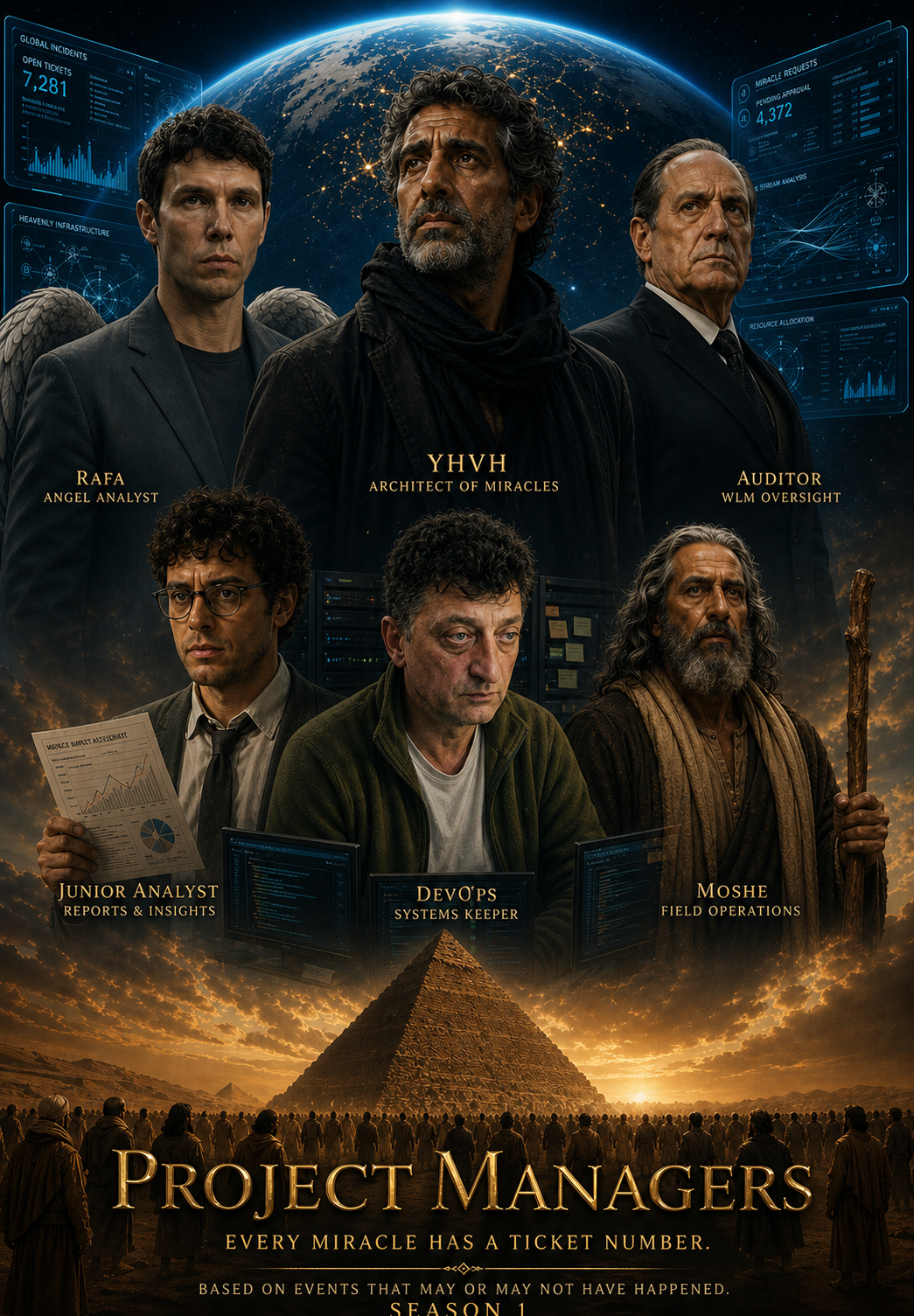
PROJECT MANAGERS
By Eugene Cuprin
Biblical miracles and ancient epics are not magic — they are technological incidents, bugs, and rushed hotfixes in the day-to-day operations of rival galactic corporations. YHVH, Zeus, Marduk, and Ahura Mazda are just exhausted C-suite executives running impossible projects. Moses, Joshua, Samson, and Jesus are field agents. And when everything crashes, only faith remains — the faith of people in their gods, and the faith of gods in their people.
SYNOPSIS:
Thousands of years ago, several advanced interstellar civilizations agreed on a principle: young worlds must not be conquered — they must be developed. Instead of invasion fleets, they send progressor teams — elite project managers of civilization — dispatched from competing galactic corporations to a young planet where human intelligence has barely emerged.
YHVH Corp is the most ambitious of these firms. Its CEO — a brilliant, bipolar visionary who simply goes by YHVH — has spent centuries monitoring Earth and has finally secured Board authorization for the most audacious deployment in galactic history: TORAH v7, a full civilization upgrade package encoded directly into human DNA. Not monuments. Not oral tradition. Not clay tablets. People.
The chosen test cluster is currently operating as a labor force inside Egyptian infrastructure. Extraction will require negotiation. And if negotiation fails — YHVH has a very convincing toolkit.
What follows is the story of that project — told over 1,250 years, from the Exodus of 1250 BCE to the destruction of the Second Temple in 70 CE — seen simultaneously from two perspectives. Above: an orbital campus. Below: pillars of fire, parting seas, plagues, and the rise and fall of empires. Every miracle the audience witnesses is, from the operations center, an emergency patch. Every plague is a misconfigured script. Every parted sea is a portal held together with the digital equivalent of duct tape.
The core team is small. Rafa, Chief of Staff, is YHVH's loyal lieutenant — sober, competent, and increasingly aware that his CEO is losing the thread between management and obsession. DevOps is the lead systems engineer who has been at his console longer than several of the cultures being monitored. He operates the weather module, manages the temporal distortion system, files every incident report, and receives every critical alert first, always too late to matter. He is the most human character in the series. He is not human at all. Rounding out the team: The Auditor, a representative of the Interstellar Oversight Board, who watches everything, says little, and writes everything down.
On the ground, YHVH's field agents are a study in the gap between corporate ambition and human reality. Moshe — a man with a stutter and a complicated past inside Pharaoh's palace — turns out to be the perfect field lead, not because of supernatural gifts, but because he is the only person who can walk into both worlds. His elder brother Aaron handles communications. Together, they execute the Exodus — ten failed production deployments later remembered as the Ten Plagues, and a sea crossing that DevOps will log for decades as REDSEAPORTAL — COLLAPSE — CAUSE UNDETERMINED. The ticket remains open. He has pinged it 47 times.
Across the season, the project scales — and destabilizes. Joshua storms Canaan using resonance engineering later called a miracle. Samson, YHVH's attempt to clone a competitor's superhuman model using a partially stolen protocol, is simultaneously the series' funniest and most tragic character: his hair works as energy antennae, and his critical vulnerability is a woman named Delilah. Samuel becomes the first locally-grown field agent — a twelve-year-old, filing compliance reports since age nine, waiting for someone to call. Solomon builds the Temple as the project's first stable permanent server, deploys the Ring OS 1.0, and delivers his final debrief in the cadence of Ecclesiastes.
Then Babylon arrives. The Temple burns. The project is declared critically degraded. But it doesn't die: it distributes. The Torah cipher propagates peer-to-peer across the ancient world. In exile, in Persia, through Ezra and Nehemiah, the architecture rebuilds — decentralized, fault-tolerant, carried in people rather than buildings.
In the final act, Jesus arrives as an emergency field agent on a last-ditch mission: activate a genetic backdoor in TORAH v7 and seed a self-propagating network of initiates before the Board outlaws progressorism entirely. The mission partially succeeds. The Oversight Board votes to shut down all progressor activity permanently. A supplementary resolution: locate and terminate every carrier of YHVH Corp's genetic modification.
YHVH refuses to evacuate.
He strips himself of all technology, and descends to Earth as a private individual. Rafa loads twelve people into a truck in the dark of 1942 and drives away. YHVH stays by the fence. DevOps logs it twice and keeps one terminal running for 140 years.
The season ends in present-day Tel Aviv. A man who looks about seventy, silver-bearded, wearing a worn scarf, sits at a corner café on Rothschild Boulevard. He watches the street with the quiet attention of someone who built this and lost it and found it again.
The monitoring feed is still active. DevOps never logged out.
Every miracle has a ticket number. The cost line never went to zero. But it also never stopped going up.
PROJECT MANAGERS
View screenplay Register / Log In

Rated this logline
Rated this logline
Eugene Cuprin This is one of the most wildly ambitious concepts I’ve read in a long time and I mean that as a compliment.
What makes it interesting isn’t just the “ancient religion explained through sci-fi systems” angle, but the fact that you’re treating mythology, faith, bureaucracy, technology, and history all with the same level of seriousness and absurdity at once. That tonal balance is incredibly difficult to pull off.
The idea that miracles are essentially catastrophic emergency fixes, misfiring deployments, and overworked project management disasters is genuinely clever because it reframes sacred history through the language of exhausted corporate infrastructure without completely stripping away the emotional or spiritual dimension.
And honestly, DevOps might be the secret emotional core of the entire thing. The image of someone endlessly logging impossible incidents across centuries while civilizations rise and collapse around him is strangely funny and melancholic at the same time.
What also stood out is that despite all the satire and cosmic scale, the story still seems deeply interested in faith itself — not mocking belief, but exploring the relationship between systems, creators, followers, and the unintended consequences of intervention.
The ending in Tel Aviv especially gives it an unexpectedly human feeling after all the massive mythology and galactic politics.
“Every miracle has a ticket number” is an incredible line, by the way.
Thank you so much for your warm words.
Rated this logline
Rated this logline