THE STAGE 32 LOGLINES
Post your loglines. Get and give feedback.

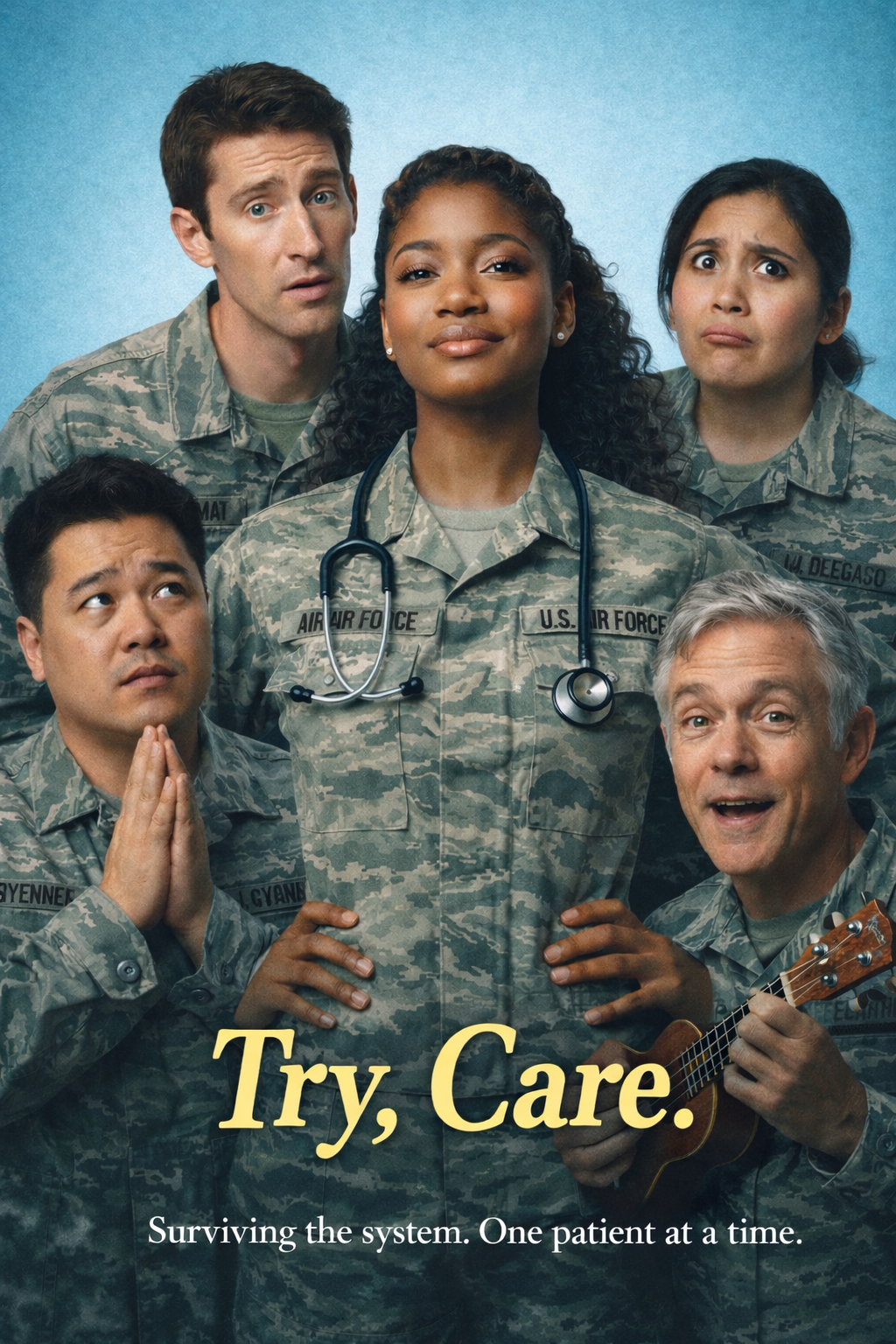
TRY, CARE.
By Micheal Camp
At an understaffed U.S. Air Force clinic on a remote base in Okinawa, a burned-out doctor tries to actually heal people while fighting a system that measures everything except whether anyone got better, a staff that measures nothing, and a quality improvement team that measures her face.
SYNOPSIS:
TRY, CARE. is a single-camera mockumentary comedy set inside the gloriously dysfunctional Kadena Air Base Clinic in Okinawa, Japan, where the bureaucracy is suffocating, the coffee maker is perpetually under caution tape, and the staff has collectively decided that "good enough" is a lifestyle.
At the center of it all is Major Williams, a sharp, exhausted doctor who genuinely loves medicine and genuinely cannot stand almost everything surrounding it. She arrives before dawn to get a head start and still loses. Her seven-minute patient appointments are sabotaged by a system requiring 42 clicks to prescribe Ibuprofen, a computer that reboots at the worst possible moment, and a colleague who barges in mid-examination to ask patients how welcomed they feel on a scale of one to ten. The scale goes up to ten. Williams aims for survival.
Her clinic is a collection of people who should not, under any reasonable interpretation of military order, be this hard to manage. Airman Gray is flamboyant, perceptive, and constitutionally incapable of entering a room without an agenda. Airman Kaylee Baker showed up from Oklahoma three months ago, adopted box braids and AAVE, and has since treated the United States Air Force as a mild inconvenience between social engagements. She can cry on command, stop on command, and has never once looked up from her phone fast enough to register a complaint. Lt. Nguyen hasn't slept since Tuesday and has been offering everyone homemade banh cam since 2am. Nobody asked. Everyone eventually takes one.
Captain Patrice Morrison is a careerist in the purest, most unself-aware sense of the word, a woman who has never met a podium she didn't like and who responds to every systemic problem with the energy of a motivational poster that gained sentience. She launches "Dancing for Donuts" while a waiting room full of sick patients watches through the glass. She considers this a win. She builds a shared Google Calendar for a man she has known for six hours and describes it as a journey. She is not wrong that it will be.
Major Schobel presses his uniform at 5am and speaks with the gravity of a man who suspects he should have joined the Marines. Colonel Sedgewick, his commanding officer, joined the Air Force late in life specifically to do the bare minimum until retirement and has achieved this goal with remarkable consistency. He plays air ukulele during briefings. He has one documented contribution to clinic leadership: the word "quit," delivered in response to a call for staff engagement, and widely regarded as his most useful directive.
Into this ecosystem arrives Lt. Colonel Andrews, a former concierge medicine doctor who left Scottsdale because he was tired of writing prescriptions his patients couldn't afford, and who now finds himself in a system that measures patient satisfaction the same way it measures coffee temperature. He and Williams recognize each other immediately, two people who actually showed up to do the job, which in this building makes them a minority.
When a Quality Improvement Team arrives to assess the clinic, armed with charts, metrics, and the news that consolidation is coming, it turns out Kadena's strongest argument for survival is also its biggest problem: the clinical outcomes are excellent. The patients just think the faces look judgy.
TRY, CARE. is about the gap between what healthcare is supposed to be and what it actually is when you run it like a government program, staff it like a lottery, and measure it like a customer survey. It is also, quietly, about the people who show up anyway.
 Register / Log In

Rated this logline
Rated this logline
Rated this logline
Rated this logline
Rated this logline