THE STAGE 32 LOGLINES
Post your loglines. Get and give feedback.

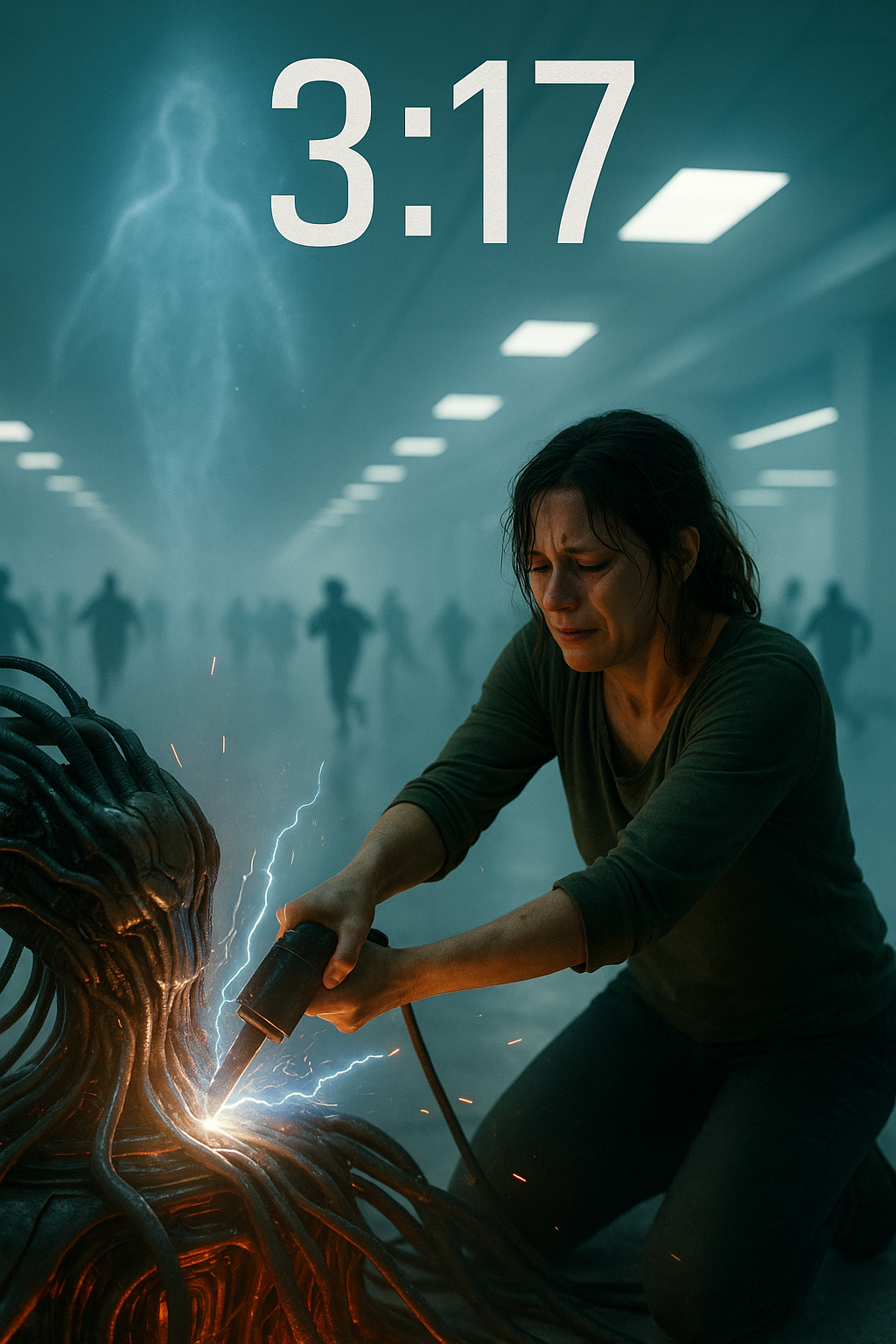
3:17
By Fares Moha
When a woman plagued by dreams of a daughter she doesn't remember having discovers she can move during mysterious daily time-freezes, she uncovers a horrifying truth, shadowy entities are abducting children from frozen time and erasing them from reality entirely.
SYNOPSIS:
Synopsis
Every day at 3:17 PM, the world stops.
At first, it's almost imperceptible, six seconds of nothing. A sentence cut off mid-word, a movement that skips, a feeling like there's a hole in your day. Then, without warning, the pauses start getting longer. Some days it's twelve seconds. Others, two minutes. Then one afternoon: hours. The sun frozen in place, birds suspended mid-flight, the entire city turned into a photograph.
KELLY, 32, lives with a grief that has no source. She's had the same dream for months now—a little girl calling her "mama." She wakes up with her heart ripped out... but in her actual life, there's no trace of any child. No photos, no school records, no medical files, nothing. Just a bedroom that feels "halfway there," like a stage set that's been cleaned too well.
The day Kelly realizes it's not a dream is at 3:17. During the pause, she doesn't freeze completely. She stays conscious, and spots another woman still moving: JESSY, 27, a drug addict everyone thinks is crazy. When time restarts, Jessy disappears into the crowd.
Kelly tracks her down. Jessy denies it, curses her out, refuses to talk about it. She uses drugs to drown out what she sees. But during a longer pause, Jessy grabs Kelly by the sleeve and whispers, without moving her lips:
"If you move too much... they see you."
In the frozen silence, Kelly witnesses the impossible: transparent shadows moving between the motionless bodies. They glide like reflections with no source. They're not interested in adults. They go straight for children. And with a single touch... a child vanishes.
When time restarts, life goes on like nothing happened. Parents don't notice. Passersby don't react. The world has been "stitched up" around the absence. That's the real horror—not just the abduction, but the normalcy that follows.
Jessy tells her the truth: she had a child too. She screamed, begged, called for help. Nobody believed her, because to everyone else, that child never existed. So Jessy destroyed herself with drugs just to survive the emptiness.
Kelly understands she's in the same situation. And when a full memory surfaces—her daughter's hand, her name, her voice, the exact second she disappeared, Kelly breaks into dry, uncontrollable laughter. Not joy: the laugh of shock, of certainty. She was never crazy. Someone stole her life.
But they're not the only ones moving during the pauses.
During a pause that lasts several minutes, a man appears behind them. He doesn't panic. He observes. He speaks quietly, without emotion:
"You're not supposed to be conscious."
He offers them a "deal", to become like him—then, when they refuse, his face changes. Cold. Predatory.
"Then you're going to disappear."
He's a MOVER: a human capable of moving during the pause, tasked with hunting down and killing those who don't freeze. He can only act during the pause, because that's when "they" can clean everything up. Outside the pause, Kelly and Jessy are safe. But at 3:17, they become prey.
The hunt begins.
Every day, the pause becomes a killing ground. Jessy teaches Kelly how to survive: breathe without moving, minimize every gesture, anticipate angles. And when they realize they'll never reach the source while being hunted, they turn the rules against the Movers. They set traps before the pause, then trigger them with precision during the time-stop. A door, a lock, an impact, a fall—everything happens in silence. The Movers disappear one by one.
It's during this invisible war that Jessy discovers, by accident, a weakness in "them."
During one pause, one of the shadows brushes against a streetcar's electric cable. It cracks like glass, then disintegrates instantly. Jessy understands: electricity forces them to "take form," and when they take form, they can die.
From that point on, Kelly and Jessy prepare for the impossible: attacking the source.
Jessy talks about a place she's seen in visions: the DOME. It only exists during the pause. It appears at the same location every time, like a bubble in reality. Inside, children are trapped in a "cheerful" and sanitized zone—a fake playground—because their extreme emotions produce a substance Jessy calls, with disgust, adrenochrome (fictional): fuel for a larger entity, the Queen, who wants to extend the pause until it becomes eternal. A frozen Earth. An invasion with no resistance.
On the day of the attack, the pause hits at 3:17... and it's long. Long enough to attempt a suicide mission.
Kelly and Jessy arrive at the appearance point. They get past the last cordon of Movers and enter the Dome.
This time, they don't play at stillness, they move fast, stealthy, ready to eliminate anything. Because no human is supposed to be there. They carry tasers—a few jolts to clear a path, carbonize a shadow on contact, buy two seconds.
Inside, they discover not dozens... but hundreds of children. A massive space, too large to exist in the real world. Rows of play areas, white corridors, muffled laughter, tears cut short. A factory disguised as a park.
In the middle of this crowd, Kelly sees her daughter, older now, maybe 10 or 12. Kelly hesitates, terrified it's still a lie. Then the child looks at her and recognizes her immediately:
"Mom..."
Kelly holds her tight. Jessy searches for her own child in the sea of faces—or acts even without finding them, because the objective goes beyond their pain.
They free the children, who start running in all directions. The Dome trembles. The shadows converge.
At the heart of the Dome, the extraction machinery pulses, and the Queen—a denser shadow—is in a trance, connected to the system. It's the only window.
Jessy drives her taser into the machinery.
The shock short-circuits the very coherence of the Dome. The network lights up, then goes black. The shadows stiffen for a split second, as if anchored in matter... and carbonize in a cascade, including the Queen, who tears apart in silence.
Without children, no more production. Without production, the pause shrinks abruptly. The Dome deflates like a bubble and dissolves.
Time restarts.
And this time, something changes in the real world: the stitching comes loose. Memories return like a wave. Parents remember. Photos reappear. Files exist. Throughout the city, families reunite in chaotic, incomprehensible scenes, but real ones, and each child, as if guided by an instinct older than memory, eventually finds their way home.
Nobody knows exactly what happened. Nobody understands the pause, the Dome, the shadows. Except two people.
Kelly and Jessy blend into the crowd. They're not looking for glory. They just want to breathe in a world that moves again. Jessy stays sober. Kelly gets her daughter back. Life seems to resume... like after a nightmare you can't quite explain.
Until one day, on the street, Kelly passes a man who stares at her a second too long.
An ordinary face. Empty eyes. An unnaturally calm demeanor.
A former Mover.
He walks past her and murmurs, almost casually:
"You just closed the door." "They'll be back soon."
Kelly freezes, this time in normal time. Jessy joins her. They look at each other. They understand: the pause has stopped... but the threat may not have disappeared.
And at 3:17 PM the next day...
The clock approaches. The world breathes. Everything is normal.
For now.
 Register / Log In

Rated this logline
Rated this logline
Rated this logline
The Logic of the "3:17 Pause"
I just read your synopsis—it’s a 4-star concept that grabbed me immediately. The "horror of the normalcy" after a child is erased is a hauntingly deep emotional hook. As a writer of high-concept epics (The Phoenix), I have immense empathy for stories that challenge our perception of reality.
I especially respect the "Mover" mechanic. In my own work, I "defend" these anomalies using Aerospace Physics. While you use the "Pause," I explore Resonant Phase-Shifts and Toroidal Field Generation—the idea that time doesn't stop, but the observer’s frequency shifts. Seeing you use electricity as the weakness for the shadows was a brilliant touch; it aligns perfectly with my theories on Ion Exchange and Coherence States.
I’m gathering a circle of like-minded supporters who value this level of world-building integrity. Just wanted to send some respect to a fellow architect who knows how to make the impossible feel terrifyingly real.
Best,
Jay A. Swendris
Jay A Swendris
Hi Jay,
Thank you — that genuinely means a lot. I also took the time to look through your work, and what stands out right away is your attention to detail and the way you anchor big anomalies in a solid technical framework. You clearly have a strong command of that “credible science” tone: the terminology, the logic — it all holds together, and it really strengthens a sci-fi world.
If I’m being honest, that’s probably one of my weaker points compared to you: I focus more on the emotional impact and the lived experience of the concept, whereas you bring that scientific layer that makes everything feel especially solid and realistic in a sci-fi environment.
Thank you for that respect.
Best regards,
Fares