THE STAGE 32 LOGLINES
Post your loglines. Get and give feedback.

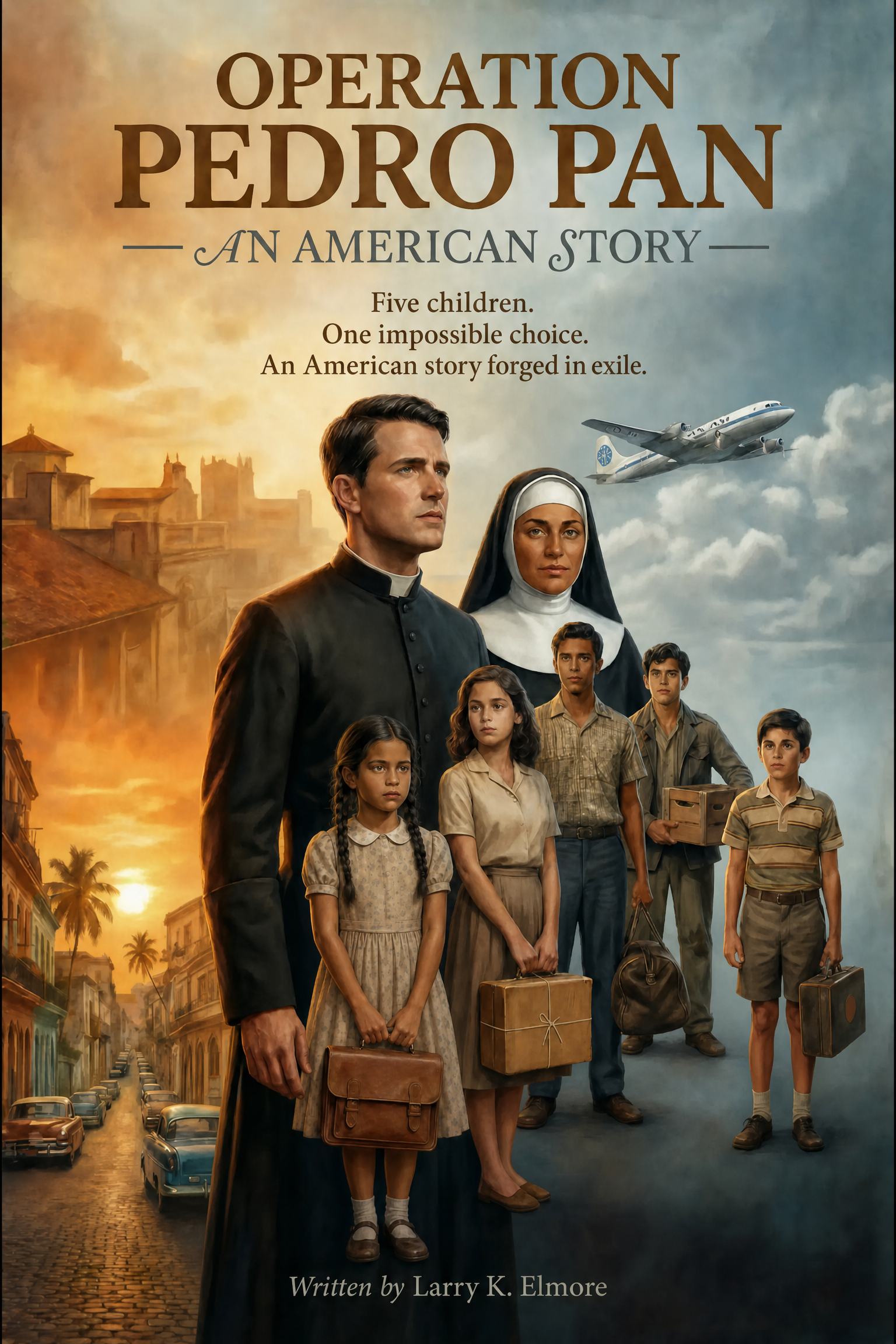
OPERATION PEDRO PAN, AN AMERICAN STORY
By Larry Elmore
As the Cuban Missile Crisis closes the skies, young Irish priest Father Bryan O. Walsh turns a State Department waiver into a lifeline for Cuban children. Five young refugees—Maria, Izzy, Rafael, Miguel, and Carlos—are scattered across America, carrying their small cases, silences, and broken promises of home as they learn to survive a separation none of them chose and build lives within its long shadow. Their rescue becomes only the beginning.
SYNOPSIS:
In January 1961, Father Bryan O. Walsh, a young Irish priest working with Miami’s Catholic Welfare Bureau, is summoned to an urgent meeting inside the U.S. State Department. With the Cuban embassy and consulates closed, officials ask him to sign waivers that will allow Cuban children to fly to the United States without ordinary visas. The document is not a visa and it promises no certainty after arrival, but in a Cuba tightening under revolution, it may be the only paper that can get a child out.
In Havana, a mother carries one such waiver through a maze of stamps, counters, and exit permissions. At the airport, she gives her twelve-year-old son a final kiss and watches him disappear into the glass-walled waiting room known as la pecera—the fish bowl. The image becomes the film’s first wound: a parent looking through glass at a child she has chosen to send away, without knowing when or whether she will see him again.
The years before the exodus reveal a vivid, contradictory Cuba of family businesses, professional ambition, and private ritual, but also repression, censorship, uncertainty, and deepening fear after the revolution. Five young people face separate versions of the same impossible family decision. Izzy Vega, the daughter of an English teacher and a skilled professional, understands that language can become both protection and escape. Maria Sanchez clings to an aunt’s Miami address, believing a familiar name can keep her from being lost. Rafael Cruz watches his physician father’s authority erode. Miguel Vargas sees fear consume a family that still believes law should mean something. Carlos Ruiz, the son of an architect, absorbs the collapse of a world his parents once knew how to navigate. Each leaves Cuba with a small suitcase and a promise that the separation will be temporary.
Walsh’s operation grows faster than any system can safely hold. When the children arrive in Miami, he and Sister Teresa face rows of metal cots, frightened children, exhausted volunteers, incomplete files, and no adequate housing plan. At the assignment desk, the five friends are divided by available beds rather than their families’ hopes: Izzy to an Ybor City foster home in Tampa; Maria, whose aunt cannot take her, to Nebraska; Rafael to Camp Matecumbe; Miguel to Camp St. John in Jacksonville; and Carlos into Miami’s adolescent system before Walsh can move him toward an artist’s studio. In a hallway marked by destinations, they stand together for the last time, then walk under separate signs.
Across America, the children learn new rules and new forms of loneliness. Izzy writes letters from her foster home while her parents wait in Camagüey. Maria learns the rhythms of a Nebraska kitchen and keeps the smudged Miami address hidden in her shoe. Miguel studies alone, trying to make sense of news he cannot get. Carlos turns inward, finding a language in drawing and the work of the artist who takes him in. In Cuba, their parents are demoted, questioned, denied travel permits, and forced to measure hope by a censored envelope or an unanswered inquiry.
Walsh and Teresa come to recognize that their rescue network carries a moral burden of its own. Parents’ letters report a frightening, unverified document claiming that the state will take Cuban children from their families. Walsh refuses to frighten parents into sending children, while Teresa insists that good intentions do not erase the Bureau’s moral burden. They conclude that official assurances will not restore faith. Instead, they send paper, envelopes, stamps, and addresses to every camp, dormitory, group home, and foster placement, so the children can write home freely and in their own words.
Then the Cuban Missile Crisis closes the air corridor between Cuba and Miami. President Kennedy’s address plays in American camps, foster homes, and Cuban living rooms while parents sit beside packed suitcases they can no longer use. At Miami airport, Walsh watches flights from Havana flip to CANCELED on the arrivals board. As he crosses out names on a manifest, the temporary separation becomes an unknown future.
Years pass. Letters continue to cross the widening divide, but the children’s lives cannot remain paused. When the Freedom Flights reopen a route out of Cuba in 1965, reunions arrive with their own shocks. Izzy’s parents reach her through Mexico and join her in Washington, where the child who once needed translating becomes her family’s anchor. Rafael helps his displaced physician father confront a credentialing system that rejects his Cuban training. Maria stands between her birth parents and the Nebraska foster mother who raised her, translating gratitude, guilt, and love. Miguel’s mother arrives alone with a censored letter: his father has been prevented from leaving Cuba. Carlos’s parents find him changed by America, and his father, once an architect, must begin again with manual work.
No family can simply resume its former life. Rafael assumes responsibility for his father’s new future. Miguel turns powerlessness into a commitment to constitutional law. Carlos finds a way for his father’s practical skill to become part of their shared American life. Maria makes room for both her old family and her new one. In Nebraska, she gives Sister Teresa a letter for Izzy. Teresa carries it toward Miami, and the message eventually reaches Washington, where Izzy recognizes the smudged address Maria had protected since intake and begins a reply. The connection does not restore the past, but it proves that the past has not been erased.
In 2001, an elderly Walsh sits in his parish study surrounded by boxes containing thousands of letters from the children he helped bring to America. He opens five new envelopes. Izzy interprets at the United Nations, still carrying the family photograph hidden in her suitcase. Rafael opens a Miami free clinic where his elderly father can again treat patients. Miguel, now a formidable civil-rights lawyer, argues in court before the father finally released from a Cuban prison. Carlos, a celebrated architect, unrolls plans for a building his father’s construction company will help create. Maria presides over a warm Cuban restaurant in snow-covered Nebraska, surrounded by the family she has made without forgetting the Havana she lost.
Sister Teresa joins Walsh as he finishes the letters. He admits that he long doubted what they had done to the children: the political compromises, institutional failures, and profound human consequences. Teresa reminds him that she has read the letters too. Cuba was lost, and exile wounded everyone. America is imperfect. Yet in countless small acts of mercy—a bed, a letter, a scholarship, a job, a door opened before anyone asked—strangers helped refugees become contributors to the country that received them. Walsh turns off his desk lamp. The screen goes dark on one more American story.
 Register / Log In

Rated this logline