THE STAGE 32 LOGLINES
Post your loglines. Get and give feedback.

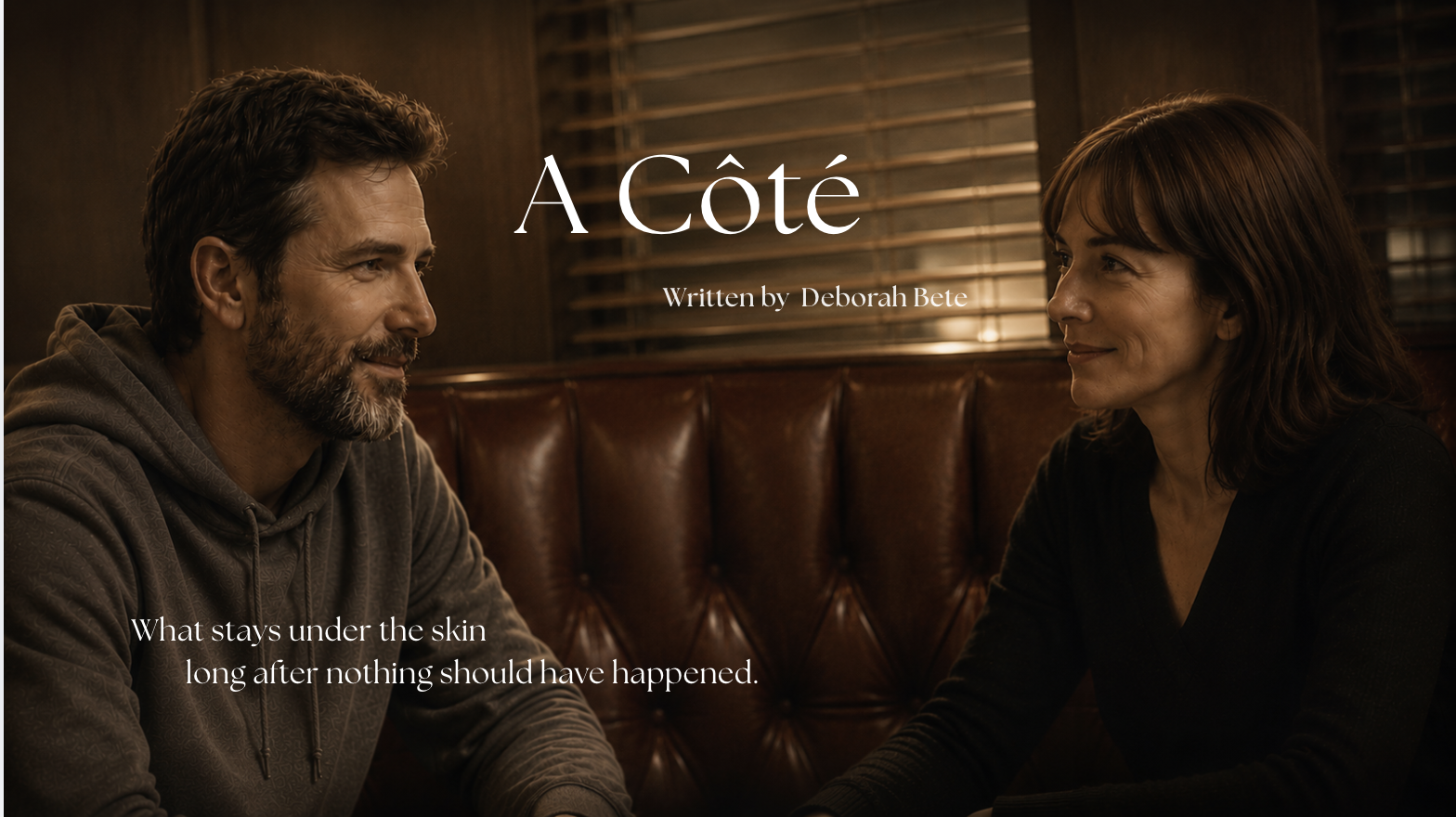
A CôTé
By Deborah Bete
When a burned-out French digital marketing executive and a disillusioned actor-director-producer meet by chance in a New York movie theater, a single afternoon forces them to confront the lives they’ve spent years performing — and the possibility of something real they cannot allow themselves to keep.
SYNOPSIS:
CHRISTIAN is a well-known actor-director-producer whose life has become another performance. ARIANE is a French digital marketing executive who has learned to disappear inside hers. Both are in New York for obligations they choose to abandon: he walks out of a production meeting about a film he no longer believes in; she leaves a corporate AI conference where emotional connection is being reduced to data points.
They each drift into the same small, empty movie theater.
They notice each other across the dark. Nothing is said, but something shifts. When the lights come up, Christian speaks first. Ariane almost walks away. She doesn’t.
What begins as a brief conversation about the film they have just watched follows them into a diner. There, their exchange turns toward the lives t
hey have spent carefully constructing: his public image, her quiet disappearance inside work, marriage, and routine.
As the outside world keeps pressing in — a stranger filming them, a waitress lingering too long, the constant threat of public recognition — they are repeatedly forced back into the reality they were trying to escape. Yet each interruption only drives them deeper into a conversation neither expected to have.
Christian speaks of what fame has taken from him, including the private cost paid by his children. Ariane reveals the slower, quieter violence of becoming invisible inside a life that, from the outside, still appears perfectly intact.
As afternoon turns to dusk, what passes between them becomes impossible to dismiss and impossible to act upon: the unsettling recognition of being fully seen by a stranger.
When the moment finally reaches its limit, Ariane leaves first. Neither of them attempts to turn the encounter into something it cannot be.
Eight months later, back in Los Angeles, Christian receives an email from his agent forwarding him a screenplay written by someone named Ariane.
The pages tell the story of their meeting in New York.
As he reads, he is pulled back into the afternoon that neither of them was meant to keep. In the silence that follows, we hear the faint sound of a number being dialed.
 Register / Log In

Rated this logline
Rated this logline
Rated this logline
1 person likes this
À Côté sounds like an interesting Art House film, Deborah Bete. I think your logline needs some work, and it’s really long (56 words). It’s more of a short synopsis.
Here’s a logline template that might help: After/when ______ (the inciting incident/event that sets the plot in motion), a _______ (the main flaw the protagonist has to overcome in the script or an adjective that describes the protagonist’s personality) _______ (the protagonist’s job/career/role) tries to/attempts to/fights to/struggles to/strives to/sets out to/fights/battles/engages in/competes/etc. _______ (goal of story and try to add the obstacles here) to/so/in order to ________ (stakes).
The inciting incident can also be at the end of the logline: A _______ (the main flaw the protagonist has to overcome in the script or an adjective that describes the protagonist’s personality) _______ (the protagonist’s job/career/role) tries to/attempts to/fights to/struggles to/strives to/sets out to/fights/battles/engages in/competes/etc. _______ (goal of story and try to add the obstacles here) to/so/in order to ________ (stakes) after/when ______ (the inciting incident/event that sets the plot in motion).
Loglines are one or two sentences. A one-sentence logline sounds better, and it takes less time for a producer, director, etc. to read it. Try to keep your logline to 35 words or less. Long loglines can make producers, directors, etc. pass on a project.
Avoid using “must” in loglines. “Must” usually means the protagonist is forced to do whatever they need to do in the story instead of doing it willingly. You might need to use “must” in a logline though, like when the protagonist is forced by another character to do something. Using “must” to choose between two options is fine.
Names in loglines are usually for biopics, well-known stories, and franchises (like Mission: Impossible).
Sometimes I put the location and date that the story takes place in instead of the inciting incident if it’s a Period Piece script.
All stories don’t follow this logline template. Biopics, documentaries, and Experimental scripts might not follow the template. The series logline for a TV show can follow this template, but the pilot logline and episode loglines for the show might not.
Rated this logline
Rated this logline
Rated this logline
2 people like this
Deborah Bete J'adore cette idee, Deborah! C'est complet de mystere, d'amour, et de un..je ne sais quais. I love that you write in French and are translating in English, I also write in several languages. I love the logline, but I would work a bit in making it a more cohesive, longer sentence instead of chopped up, although I understand why you do it...it gives that cinematic feel.
Rated this logline
3 people like this
Juliana Philippi I actually have different loglines — it depends on the context.
Rated this logline
1 person likes this
Bonjour Deborah Bete The concept instantly has me hooked, it's quite immediate and palpable.
2 people like this
Juliana Philippi Thank you. Just to clarify: I actually write directly in English, it’s not translated from French. I’m glad the logline resonated with you.
2 people like this
Marie Hatten thank you so much, Marie. That really means a lot. I’m glad the concept came through so immediately. Your message genuinely warmed my heart.
Rated this logline
1 person likes this
Deborah Bete Vous êtes les bienvenus
Rated this logline
2 people like this
Great work
Rated this logline
Rated this logline