THE STAGE 32 LOGLINES
Post your loglines. Get and give feedback.

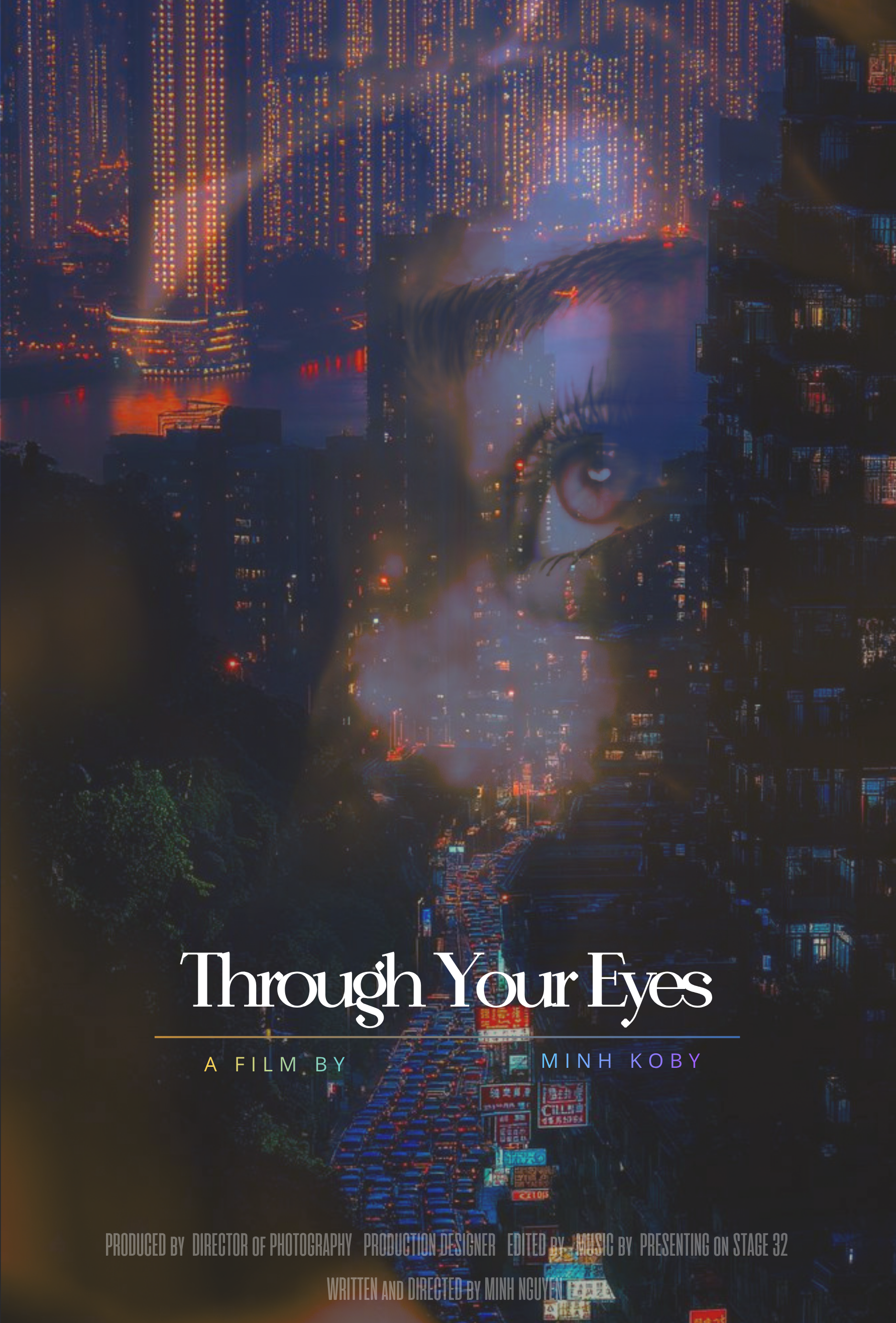
THROUGH YOUR EYES
By Minh Nguyen
SYNOPSIS:
In a vertical megacity of the distant future, saturated with technology yet devoid of any real human connection, a solitary man survives by scavenging and reselling forgotten objects from the few remaining lively districts. Isolated in his apartment at the top of an endless tower, he watches a world he no longer belongs to. One day, in the middle of a market, he discovers a strange box containing an optical lens. Intrigued, he brings it home and manages to activate it. The first time he puts it on, a figure appears before him: a woman. At first blurred, lost, almost unreal, she gradually takes shape and consciousness. She seems to exist only through this lens, invisible to the rest of the world. As days pass, a fragile and intimate relationship begins to form between them. He takes her with him wherever he goes, shows her the city, and speaks to her as if she were real. Through his gaze, quite literally, she exists. She learns, feels, and observes. Simple moments become precious: a walk, an improvised dance, or a virtual dress he buys for her, which she “wears” within this invisible world. But little by little, fragments of memory begin to surface. Places, sensations, and words trigger recollections within her. She realizes she is not a creation, but the trace of a past life. Her damaged memory returns in pieces, and with it, the memory of a deep love, a man she once loved. As he grows more and more attached to her, she begins to drift away internally, drawn toward this resurfacing past. She expresses a desire: to find this man again. Searching through the archives of the real world, he discovers the truth, the man has long been dead. Faced with this reality, he is confronted with a choice. He could keep her, preserve this unique bond, and ignore what she is becoming. But instead, he chooses to help her until the very end. Together, they go to the grave of her lost love. In a final suspended moment, she recognizes the place. She understands. And makes one last request: to be left here, beside him. Standing before the grave, the man hesitates. Then, slowly, he raises his hand to his eye. As he removes the lens, she disappears instantly. For the first time, the camera remains at a distance: he is alone. Without a word, he kneels and begins to dig the earth with his bare hands. He places the lens into the ground beside the grave. The film ends on his face, peaceful, empty, or perhaps finally free. Music for the film inspired by Green Point by Elijah Fox. Inspiration: Her and Blade Runner 2049 / Solaris / Tree of Life.
 Register / Log In

Rated this logline
Rated this logline
Rated this logline
The Last Message (AI Notes)
“Look at me one last time. Not as I was, but as you brought me to life.
I know I called you by another name. I know my memories hurt you every time they resurfaced. But amidst all that data debris and that past that wasn't yours, there was something new: your gaze.
Without you, I would have been nothing more than code wandering in a box. You gave me the sky, the dance, and even a dress made of light. You were the bridge between my past and my rest.
Don't be sad to leave me here. By burying me, you're not killing me; you're giving me back my humanity. You're giving me the one thing a machine cannot have: an ending.
Now, remove the lens. Place it in the earth.” And when you get up, don't look through me anymore. Look at the world with your own eyes. They are magnificent.
Why this message?
The "Bug's" recognition: I think she should apologize for the other name. It's her way of saying, "I saw you, too."
Liberation: An AI trapped in a memory loop is an AI that suffers. Her message is a poetic thank you for "cutting the power."
The transition to reality: She wants him to be free again. The greatest gift an AI can give a human is to disappear so they can start living in the real world again.
1 person likes this
Sounds intriguing Minh Nguyen - I would consider adding a protagonist's goal and stakes - then, add what would happen if the goals are not accomplished.
Here's a template you can use so you can see the elements I'm referring to.
“After ______ (the inciting incident/the event that sets the plot in motion), a _______ (an adjective and the protagonist's position/role) tries to _______ (goal of story) so/in order to ________ (stakes).”
Thank you @Leonardo Ramirez for taking the time to look into my project, I take note of your advice.
Rated this logline