THE STAGE 32 LOGLINES
Post your loglines. Get and give feedback.

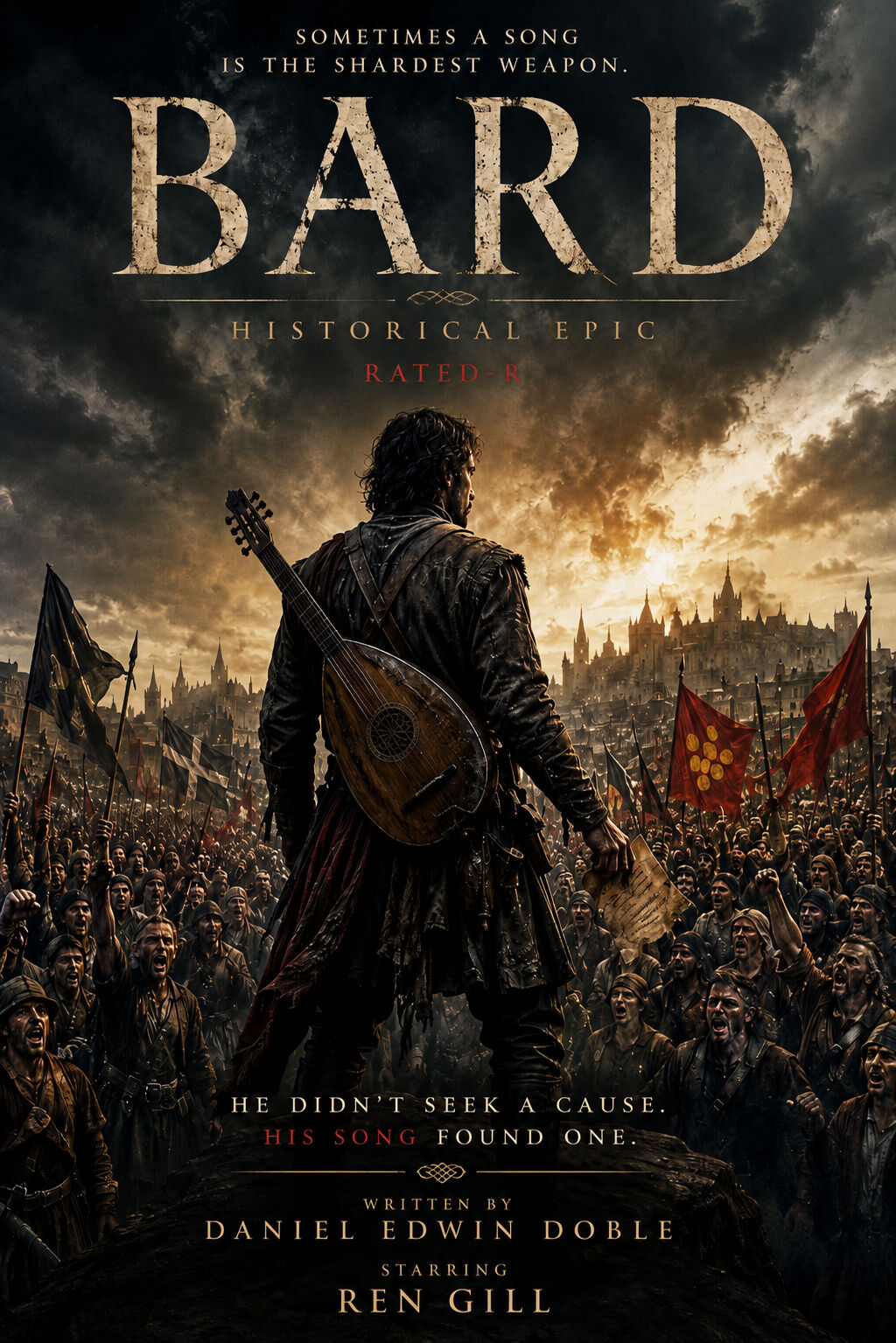
BARD
By Daniel Doble
When a charismatic Cornish musician joins a commoners' rebellion against King Henry VII, his songs inspire thousands to march on London—but his true calling becomes preserving the memory of the ordinary men who dared to stand against a king.
SYNOPSIS:
ACT ONE
In the Cornish village of Lezant, charismatic tavern musician Bartholomew Blackburn earns his living performing satirical songs mocking King Henry VII's crushing taxes. His carefree life revolves around music, laughter, and his relationship with innkeeper Tammy Trevice, who dreams of a quiet future together.
When thousands of Cornish miners, blacksmiths, farmers, and fishermen begin marching west in protest of a new tax imposed to fund a distant war against Scotland, Bartholomew watches history pass through his village. Rebel leaders Michael An Gof and Thomas Flamank arrive at the tavern after hearing one of Bartholomew's songs celebrating the growing uprising. Recognizing the power of his music, they ask him to join the march and become the voice of the rebellion.
Despite Tammy's desperate pleas to stay, Bartholomew leaves everything he knows and joins the fifteen-thousand-strong host marching toward London.
ACT TWO
As the Cornish army crosses southern England, Bartholomew's songs spread from camp to camp until entire towns greet the rebels by singing words he composed beside their campfires. His music unites ordinary people across county lines and transforms a local tax protest into a national movement.
In Somerset, the rebellion reaches a turning point when James Tuchet, 7th Baron Audley, abandons privilege to join the commoners under the leadership of a village blacksmith. Bartholomew witnesses the barriers between noble and commoner begin to dissolve.
The march reaches Winchester, where cracks begin to appear beneath the movement's confidence. The leaders debate their next move and gamble everything on the belief that Kent will rise in support. Bartholomew realizes for the first time that Michael An Gof is not an infallible hero but an ordinary man carrying impossible responsibility.
Outside Guildford, the rebellion suffers its first bloodshed when royal cavalry ambushes the column at Gill Down. Though the losses are relatively small, the psychological impact is devastating. Bartholomew buries friends, discovers that songs cannot shield men from death, and begins recording the names of the fallen instead of writing lyrics. Guided by veteran marcher Gwilym Gillian, he starts to understand that a true bard's purpose is not merely to inspire—but to remember.
The rebels finally reach Blackheath overlooking London, only to discover that Kent has failed to rise and that King Henry VII's vastly superior army waits across the Thames. Overnight, six thousand frightened men quietly abandon the rebellion. Bartholomew watches the remaining nine thousand choose to stay, realizing that courage is not the absence of fear but the decision to stand despite it. He embraces his true calling—not as an entertainer, but as the keeper of his people's story.
ACT THREE
At dawn on June 17, 1497, the remaining Cornish host marches silently over the ridge at Blackheath to face overwhelming odds. Rather than witnessing the battle itself, Bartholomew's voice recounts the rebellion's tragic conclusion: the defeat of the Cornish army, the executions of Michael An Gof, Thomas Flamank, and Baron Audley, and the long journey home for the surviving rebels.
Bartholomew returns to Lezant forever changed. Walking back into The Tamar Lantern, he is welcomed home by Tammy, but the carefree musician who once entertained the village has become something far greater. Carrying not only his father's gittern but the names and stories of those who marched, he prepares to give voice to the ordinary men history might otherwise have forgotten.
The bard has finally found his purpose—not to sing for applause, but to ensure that those who stood together against injustice are remembered for generations to come.
 Register / Log In

Rated this logline