THE STAGE 32 LOGLINES
Post your loglines. Get and give feedback.

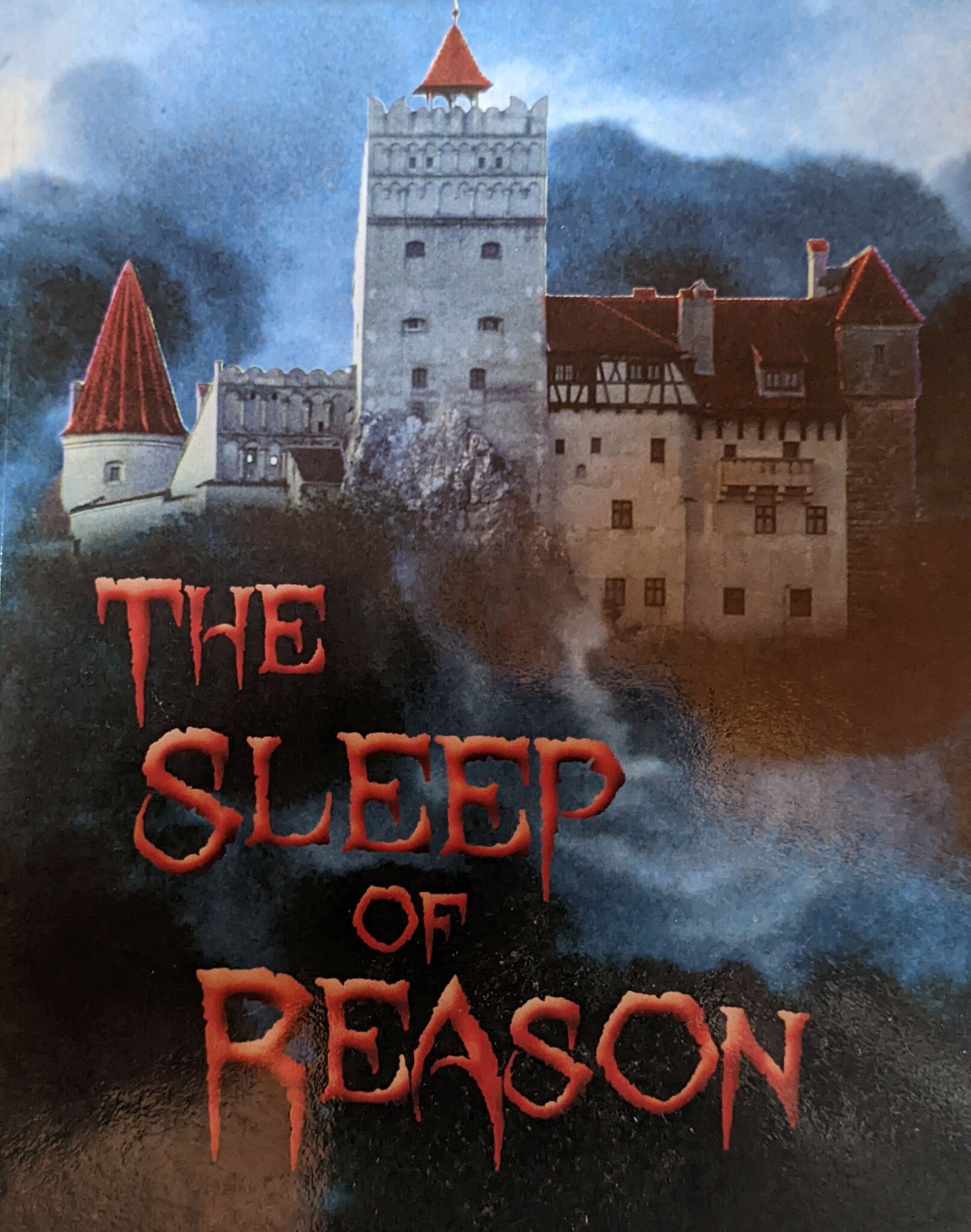
THE SLEEP OF REASON
By Lee Matthias
After his bride disappears on their European honeymoon, Richard Renfield traces her to a castle ruin in the Carpathian mountains, and confronts its undead inhabitants, determined to restore her to life and bring her home. (A prequel to Bram Stoker's story, DRACULA)
SYNOPSIS:
Note - This script was written before LAST VOYAGE OF THE DEMETER (by my friend, screenwriter Bragi Schut) and the Nicholas Cage film, RENFIELD, were both written and produced. It is a serious attempt at a prequel to Bram Stoker's DRACULA. Because the films listed above have been produced, I am aware that there may be little current interest in another Dracula-based film for the present. However, this script deserves life, and a place here.
WHY THIS FILM NOW? Has no one ever wondered how Vlad Dracula could, in the original novel, be in psychic contact with the lunatic, Renfield before Vlad has ever been to England? They must have met earlier! And how did Renfield survive it? Therein lies a tale. It’s about time!
I’ve always had problems with the concept of vampire stories in general, and Bram Stoker’s tale, DRACULA, in particular. First, the mythology of vampirism holds that after the vampire bites its victim, either soon, or over several similar attacks, the victim also becomes a vampire. This seemed to me to be an “Achilles Heel,” because, much like “the miracle of compounding interest,” legions of newly-created vampires would soon over-run the world.
Second, Bram Stoker’s novel begins splendidly, but after the “first act,” in the English section, it becomes a kind of 19th Century “soap opera,” with its dreary “classist” social scene. Fortunately, with the chase back to Transylvania, it manages to get back to a terrific and compelling narrative drive and denouement in “Act 3”.
And, so, in THE SLEEP OF REASON, I discovered the answer to my vampire population problem, not to mention the “dreary” confines of 19th Century England.
THE SLEEP OF REASON is a prequel to Bram Stoker’s story: how the madman, Renfield met and survived his first encounter with Vlad “Dracula”. And, this story mainly transpires where the original should have: in that ruin of a castle in the Carpathian Mountains. The narrative moves across 30 years, with the 1895 Renfield, a broken resident of Carfax Asylum, patient of Dr. Manfred Devorer (Dr. Seward’s predecessor), one of the new breed of psycho-therapists, and a rival of Freud. In a harrowing series of sessions, Devorer dissects Renfield’s memories, forcing him to re-live it and fall to the distant vampire’s psychic domination:
On a business trip to America during the Civil War in 1862, Englishman, Richard Renfield, in New Orleans before its fall, meets a young woman, Elsbeth, rescues her from an abusive employer, they fall in love, and he whisks her out of the war, and, with him, back to England. Against his family’s classist wishes, he marries her, and is promptly disowned. No matter…
On their honeymoon, a backdoor tour of the real Europe (i.e., “on the cheap”), Renfield’s bride vanishes from their hotel room. Shattered, Renfield sets out to find her, searching fruitlessly for months. Eventually, a shell, now, of his former self, he returns to England. Finding no direction or happiness, he enters a seminary, training for the priesthood. But, just prior to Ordination, realizing that he can’t get past the possibility that, Elsbeth may still be alive, he puts a “stay” on his Ordination. And, so, with all the spiritual fortitude and knowledge of a priest, but not yet wedded to its moral and ethical constraints, he returns to eastern Europe, determined, now to find her, armed with a new, spiritual vigor.
In the village where she had disappeared, after consulting with experts in Budapest, he redoubles his search. Eventually, he discovers a link to his wife through a Gypsy wine merchant--supplier to the inn-keeper where they had stayed--and an old peasant woman living outside the town. The Gypsy tells him of a castle ruin in the mountains, hinting at a connection. So, Renfield hires the man to take him there.
Ascending through the wild country, they finally arrive at the castle, straddling a jagged peak. Approaching the ruin’s massive, studded door, Renfield attempts to enter, but finds it locked and barred. The Gypsy refuses to go further than the courtyard. He sets up a tent alongside the wagon, and places various “armaments” and strange “barriers” at its entrance. He leaves the wagon to Renfield. With darkness and a storm coming on, Renfield decides to gain entry to the castle in the morning, and settles in for the night.
The Gypsy had provided Renfield with a unique wine distilled, with a variety of masking fruits, from garlic. As the storm arrives, and Renfield steels himself with the wine, he’s bitten by a large “spider,” and begins to hallucinate. Then, visited at the storm’s peak by something crawling on the wagon’s roof, he smashes his way out, and staggers to the jagged castle wall. He begins to climb amidst the pounding wind and hail, the furious lightning, and the sheeting rain. A hundred feet up, with the storm raging around him, almost falling, he manages to reach a window, pull it open, gain entry, and collapse, exhausted.
The next morning, after un-barring the castle entrance, he discovers the Gypsy has fled. So he explores the huge structure from its highest turret to its subterranean dungeons. He finds it strangely furnished, yet, apparently deserted. Eventually, however, he meets its undead residents, including, finally, his lost bride, Elsbeth, now a vampire consort of Vlad Dracula. With the Gypsy’s safeguards, however, he’s able to protect himself while confronting his supernatural adversaries: the King Vampire and his disaffected concubine, Elizabeth Bathory (“Ba-tory,” history’s Blood Countess). Using his innate intelligence and priestly training, he’s able to manipulate the complex sexual politics which have come to hold the castle’s residents in thrall.
Gaining insight into his host, he’s able to learn the vampire’s plans for him, and then, discern opportunities to regain his wife and, so, to escape. What follows is an escalating war of wills. Renfield: “Your people are dead but do not know it. Mathematics is your undoing once your numbers are sufficient to overcome the living birth rate. You call yourself immortal, but you are the embodiment of the doomed.”
Then, without transforming him into an “undead,” Vlad forces Renfield to experience “life” as a vampire. So, after deducing how the vampires control their numbers, he begins to form a plan. Working while they “sleep,” through one long day, he gathers silver from the kitchen’s stores, uses the forge from the livery, builds a cache of weapons, and sets a series of traps with which he intends to destroy them, freeing Elsbeth.
Meeting his undead wife one final time outside the castle just after sunset, he implores her to leave with him. For just a moment his “living” bride seems to revive. Elsbeth: “Richard. Imagine our return to England. You’ll go back to your firm. We’ll get a house. You’ll work through the day, come home late, but it will be alright because I’ll just be rising. Perhaps I’ll grow moonflowers because they bloom at night. You’ll need to keep your drinking habit, perhaps find another gypsy to supply—“ “---STOP!!!” he howls, turning away. Finally, after regaining himself and turning back, he finds her gone.
Then, in a wild denouement, an apocalyptic war of Good vs. Evil, Renfield attacks his vampire hosts to free his lost love. He almost succeeds. But, after destroying Elizabeth, Vlad’s concubine, yet failing to kill Vlad or rescue Elsbeth, he’s left only to save her from an eternity as an “undead”. Somehow after that, in a vicious struggle beneath the castle’s subterranean charnel house, he manages to escape, a shell of what he was, and finds his way back, eventually, to England and into the “therapeutic” care of the “good” Dr. Devorer. And, in the process, in a twisted, protective, final self-defense, he submits to his memories and Vlad’s domination.#
 Register / Log In

Rated this logline
Rated this logline
Rated this logline