THE STAGE 32 LOGLINES
Post your loglines. Get and give feedback.

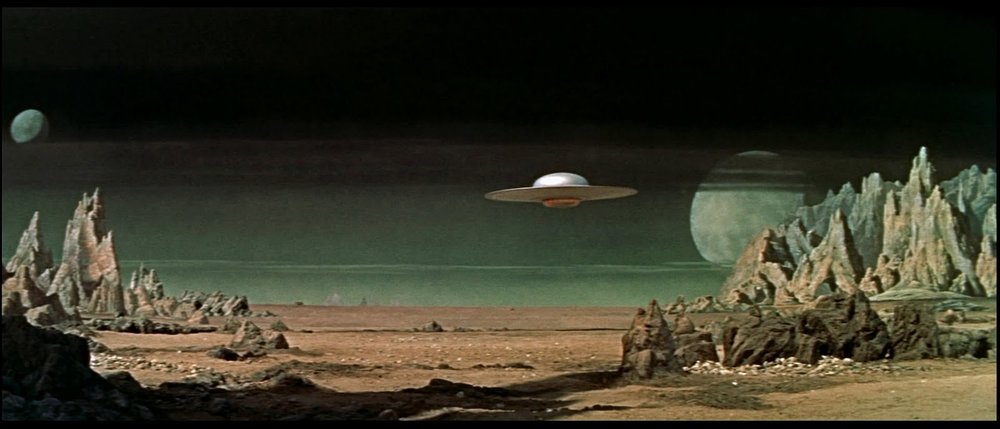
FORBIDDEN PLANET (REMAKE CONCEPT)
By Lee Matthias
I know: "How dare I?"
SYNOPSIS:
Give me a chance (and remember, the original’s still there; and, dude, it’s only a movie!):
First of all, it should be known that Hollywood has been playing around with re-making FP for decades. Recently (for those of us over 40), around 2008, it was announced with a script by J. Michael Straczynski (BABYLON 5, SENSE8, THE CHANGELING - Clint Eastwood’s drama, not the superb ghost story starring George C. Scott). As it happened, his script became a prequel story of the ship and crew that first went to Altair 4. I read it, and it is good. But, for whatever reason, it never made it to production. Before Straczynski, writer Nelson Gidding (I WANT TO LIVE, THE HAUNTING [orig.], and THE ANDROMEDA STRAIN [orig.]) now deceased, R.I.P., took a crack at it. In the mid-1990s, he wrote a remake script, a treatment for a sequel, and a sequel script. Also in the 1990s, screenwriter Denny Martin Flinn (STAR TREK VI - The Undiscovered Country, THE DECEIVERS) also deceased, also R.I.P., wrote a remake script. I have them all, but, in order to avoid being influenced, other than Straczynski’s prequel, I haven’t read them. Most recently (November, 2024), Warner Bros. announced a remake in development with screenwriter Brian K. Vaughn (LOST, UNDER THE DOME, THE VAULT) but it’s not listed among his upcoming projects at the IMDb. So, aware that such announcements never guarantee a successful result, I decided to throw my hand in the ring.
I believe a film might be justifiably remade if there are cinematic, technological, and/or casting reasons why the idea would be appropriate, rather than shamelessly going for the quick buck.
Today, the original film, with its 1950s sensibilities, seems dated. The old-school military-styled space-ship and crew; the short-skirted love interest, Altaira;
the testosterone-oozing male rivals vying for her;
"She called me Shirley! What if the guys find out?"
the cute robot; all of these elements, while charming in a ‘campy’ and nostalgic sort of way, would undoubtedly need updating, muting, or elimination entirely.
The original scenario: Far in the future, an interstellar colony ship travels to the Altair star system and is never heard from. Decades later, a rescue ship arrives and is warned off by colonist, Edward Morbius. The rescuers land anyway. Eventually they make contact with the survivors: only Morbius and his daughter, Altaira (conceived en-route, her survivor-mother, now dead). They live with a remarkable robot, Robby, unexplainably designed and built (somehow) by Morbius. The film’s action, then, is the story of what happened in the past, and what is done about it now.
The attractions of the film include:
Altair-4, the truly alien world – though it is not that it is inhospitably alien, but rather that it is just weirdly alien enough. I read the original novelization (a signed, [by Anne Francis], copy is selling for $4000; used, unsigned copies, are selling for $45) years ago, and the planet was strange and wonderful, as described in the book.
Robby, the Robot – because he is human-like, yet pure technology; smart and powerful, yet endearing. This pre-figures Star Trek: The Next Generation’s android, Data. But the danger here is to either make Robby too cute or too Data-like. Some other re-imagining of Robby is needed (and it shouldn’t be Spock-like, either).
The long since vanished aliens, the Krell – because they are so impressive and because of the mystery of their disappearance—which pre-figures Fred Pohl’s Heechee civilization from GATEWAY.
The Krell’s brain-booster as a means to enhance and amplify the mind.
The idea of ‘monsters from the id’ as a concept.
So, what could be done with these that would make the film worth updating? Well...
Increase the time interval from the original film’s 20 years to 50 years in order to better reflect the scale of things, and introduce human technological advancements since the original expedition left Earth.
Morbius and his daughter’s sole survival since arrival is a mystery, and his inability (or unwillingness) to account for it sets the mystery of the story in motion.
Morbius, while unable to prevent his wife’s death, has, since arriving, somehow halted his and Altaira’s aging so that he remains at age 45, and Altaira at age 25, rather than at their true ages of 95 and 50 (she was conceived en route, so her age is only 25), respectively. While humanity on Earth has been able to more than double the human lifespan, Morbius has been able to somehow arrest it entirely since his arrival on Altair 4. The mystery deepens.
The alien world could be better realized through a carefully controlled and understated use of CGI and great production design. First, the planet, Altair-4, could become just an entry-way to the real world of the Krell, a fantastically larger world (think Larry Niven’s RINGWORLD): perhaps a kind of “web-world,” a spherical, geodesic construct of inter-connected arteries and nodes composed of some kind of “dark matter” unseen in normal reality, surrounding and so, enclosing, the star, Altair, itself. These arteries, in turn, would inter-connect dark matter-composed, fourth-spatial-dimensionally (tesseract-like) planet-sized nodes (but spatially 3-dimensionally, just asteroid-sized), as habitats, gravitationally stable around the star, yet spinning, so, not in orbit. And all of it would be, as is dark matter, itself, (initially) undetected, yet bound by gravity. Perhaps it’s out-of-phase with known reality so that, like dark matter itself, it is un-detected until deduced by its effect on gravity readings, and confirmed later via the brain-booster machine. And then it is entered into via a Gateway on Altair 4, revealing itself as a series of worlds fantastically more varied (think monumentally vast, wildly colorful, full of exotic life), with huge, deserted cities full of inscrutable Krell technology. And, all of it powered by an infinity of zero-point energy (the power running the planck-length-sized quantum foam) drawn from the never-ending oceans of “emptiness” surrounding and enclosing it, the universe itself. (NOTE - it’s been calculated that a mere coffee-cup sized amount of zero-point energy could boil all of Earth’s oceans)
Robby, in this updated version, built by Morbius using the Krell’s brain-boost interface, is an artificial being, a man-child, yet, with immense mental abilities. He’s a being who intellectually experiences everything humans do, but does so, amplified exponentially through the collective knowledge-base of the Krell. He’s a character who has the wisdom of an ancient: vast awareness, deep empathy for human potential, respect for human aspiration, empathy for human tragedy, and an appreciation of basic noble and ethical goodness. He draws upon enormous Krell databases and historical records. He’s a character with the innocence of a child, someone who is a kind of reversal of the God/Man-perfect/imperfect relationship, where Man is his God. And, he’s artificial, immortal, attuned to the finest, most delicate of human subtleties, capable of the greatest technological and mental achievements, and so, effectively better (not, merely stronger) than his creator. And he’s someone who has extrapolated humanity’s future and may know its destiny, yet, knowing what such knowledge might do, resists all human efforts toward gaining its revelation.
The Krell, an ancient race from another star in another galaxy that was entirely consumed by the super-massive black hole the galaxy once surrounded. They ultimately re-located to this galaxy and the Altair system and transformed it as humanity finds it, having evolved on a far-slower scale than that of humanity. They took 20 million years of their own evolution from primitive hunter-gatherers to reach space, compared to humanity’s 1 million (since the dawn of Homo Erectus), and they took another 5,000 years to achieve interstellar travel compared to humanity’s 100 from Apollo to the first trip to Alpha-Centauri. This implies that while humanity may have greater potential than the Krell because it learns faster, it also may risk destroying itself because its advancement is too fast, and its nature is war-like.
And so, we learn of the Progenitors, here-called, “The First,” a race Morbius deduced and named via the Krell brain-booster, whose traces the Krell encountered when they first ventured into space millions of years ago, a race long-vanished, who were from one of the earliest third-generation star systems (the earliest stars capable of generating life and supplying all the elements of the periodic table). Therefore they were, perhaps, one of, or the first-generation life form, billions of years older, even, than the Krell.
Despite the unimaginable vastness of the universe, it was “The First” who understood how much the product of accident and fortuitous coincidence, and therefore, how impossibly rare advanced intelligent life, as opposed to mere life, truly is: the sheer number of fortuitous accidents, climate, volcanic destruction, floods, disease, competition with other predators, extinction through competition with itself, the Earth’s magnetic field. And then there were the cosmic lucky-breaks, such as being missed by, or benefiting from, asteroid bombardment, stellar mass ejections, gamma ray extinction, the vastly over-sized (compared to other planets’) Moon, itself, allowing life to flourish through tidal influence, etc. All that allowed humanity to evolve to the state of civilization. And then another layer of fortuitous accident: avoiding destroying itself through war or environmental destruction. The unlikeliness was simply… beyond.
When, finally, after searching for eons, the only intelligence The First ever found was the Krell, they engineered their own discovery by the Krell in order to amplify the Krell’s progress. It worked, and the Krell learned much of their titanic knowledge from that discovery. Now, the Krell, too, have vanished (Morbius’s tests confirm the last Krell walked these corridors more than a billion years prior). What happened to them? Could their discovery by humanity have been intentional, to amplify us, just as they had been amplified before us? And, if so, what is our destiny? And how must we wield such knowledge, such power? For whom? For what purpose?
The brain-booster isn’t merely a device that enhances a neural structure such as a human brain, but rather, it is a device that makes a human mind fully active, ‘turned all the way up to its physiological maximum,’ so that it, in turn, is now capable of interfacing with the artificial ‘neural network’ of the Krell, themselves. Yet even this does not gain them access to the full Krell/”First” knowledge-base. Only Robby can access that. Much as the light of the sun blinds, humans would be overwhelmed by the immensity of Krell/”First” experience and intellect. They would die in the attempt. So they gain the towering mental potential from which the Krell built their world and technology, but only at the lowest, most rudimentary level. And yet, even that is a level Robby tells them humans would not reach for tens of thousands of years.
Monsters from the id: a notion that, using the Krell brain boosting device, a being’s darker side will be boosted along with the lighter, ego-side; the now, super-powerful id is able to manifest as a monstrous negative force, physically composed (in our version) of ‘anti’ dark-matter, and drawing upon the zero point energy powering the still-running Krell infrastructure. This entity, the super-id, now threatens, through un-bridled power, to dominate and defeat the undefended super-ego and so, the being, itself. This is the heart of human potential: the id/ego tension that simultaneously is responsible for human creativity and its war-like nature. This is what makes humanity so potent, compared to other life. And this is what threatens humanity with extinction, should the delicate balance be upset.
This detail, in our update, is ultimately seen to be a ‘device,’ trickery designed to mis-direct, to shield and conceal the truth of what happened to both the Krell and their own mentor-race, the First: that the Krell and their predecessors both hide, effectively in plain sight, by having enfolded themselves and their existence within the dimensions of 11-dimension space existing at the sub-atomic scale in wave/particle duality. They have, in fact, shrunken themselves down to an existence at the quantum foam level of vibrational energy where demands of the physical, baryonic self, survival, energy-dependence, influences of environment (including, even, time) are non-existent. They live now as ‘mind,’ in a place where even the far-future “heat-death” or “big-crunch” of the universe (pick your poison) will not end their existence. It amounts to a kind of ‘heaven,’ accessible only to beings whose mental states and physical capabilities have advanced to the point where they can transit to such an existence. It is, in fact, a state lying at the end of humanity’s evolutionary path, provided it can reach it without destroying itself or dying out in some other way.
In the end, our humans finally communicate with the Krell (“The First,” too), through Robby, whose ultimate tragedy is that while he can see essentially all, he cannot achieve such existence himself. Thus, it, at first, appears he is destined to end his existence alone some trillions of years in the future, when matter, itself, breaks into its fundamental components, its binding energy depleted, or it collapses to a null-time singularity.
So, while the denouement is, at first, a titanic battle with the id-monster; ultimately it is, with a dying Robby’s help (now, mortally damaged by battling the id), seen, now, as a battle with one’s own reason. And when they realize that, and convince Morbius of the truth of it, his own ego pushes the monster aside as easily as one swats a mosquito. But it’s too late for Robby, and too late to save the Altair system and the Krell’s stellar habitat, now irretrievably disintegrating under the onslaught of the id monster’s assault. The star, Altair, itself now boosted by the Krell power generators imminently falling into it, is in a run-up to going ultra-nova (thanks to the power boost of those power-generators).
This allows them just enough time to phase-change out of the dark-matter web-world and back to the gateway on Altair-4, and so escape to their ship and out of the system. So, Morbius and his daughter live, but Robby and all he knew and could connect to: the Krell, the First, and the knowledge of the universe, itself, all of it is lost until the time humanity either achieves it of its own evolution, fails in the attempt, or destroys itself.
All of these ideas could be terrifically-realized by state-of-the-art motion picture technology and production design. And none of these ideas violate the essential premise, the core spine, of FORBIDDEN PLANET. For me they make for a worth-while re-make, a FORBIDDEN PLANET for today. #
This is a concept only, nothing beyond a proposal.
 Register / Log In

Rated this logline